Operation Backlog Completion 2025
Oct 222013
 

I don’t want to give the wrong impression with this post title. I sort of liked Jonathan Maberry’s The Wolfman. Depending on when you ask me, I might even tell you I liked it a lot. I certainly enjoyed the book for a while, but as it got closer to the end, its appeal diminished. I’ll get to that in due time, so there will be spoilers in this post.
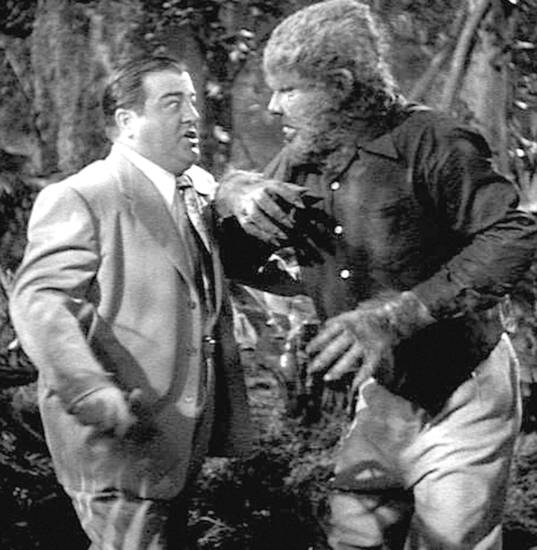
At least it really was Lon Chaney, Jr.

At least it really was Lon Chaney, Jr.

First, though, I’d like to briefly talk about werewolves, wolfmen, whatever you want to call them. Of the classic monsters, I’m the least familiar with them. Off the top of my head, I went into this book most familiar with Angua von Uberwald, Remus Lupin, Chris Jennings, Quentin Collins, and Lawrence Talbot. But don’t get your hopes up at that last one–I haven’t seen the original The Wolf Man movie, either. Instead, I’ve seen Talbot in Abbott and Costello Meet Frankenstein. So if I say anything that suggests I’m missing the point, well, I don’t have as much knowledge about this particular monster.

For example, is there a difference between a “wolfman” and a “werewolf”? Years ago, I thought there was, but more and more I think the two terms are used for the same thing–a man who transforms into a wolf (usually at the full moon). The Wolfman confused me even further about this near the end (spoilers!) when it arbitrarily assigns the name “The Wolfman” to one character and “The Werewolf” to another. I did appreciate that Maberry did something to keep track of who was who in that scene, but it also felt to me like there should be something significant about the names if they were to be assigned that way. It bugged me.

I have not seen the movie that this book was adapted to, so I cannot compare the two. I will say that I’ve read several novel adaptations of movies and games. Sometimes they work really well, and other times it’s painfully obvious that they’re adaptations. This fell somewhere in the middle for me.
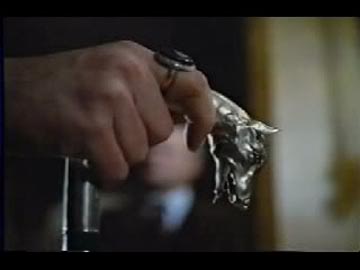
Then again, no one was beaten with it.

Then again, no one was beaten with it.

Back to the story overall, I liked the first half of the book or so. It might have had a slow start, but I liked the mystery and the atmosphere. I also liked that a random Frenchman gave Lawrence a silver wolf’s head cane, because I liked to pretend it was Barnabas’s cane from Dark Shadows. (Since then, I’ve read that the cane was featured in the original Wolf Man movie. I still like to pretend it belonged to Barnabas.) It also was a sword, which made it even cooler. I’m glad it had a role in the plot at the end, because I was starting to wonder if they’d forgotten all about it. It confused me that Lawrence seemed to sense some malevolence from the wolf’s head, but by the end I decided that maybe it was because of his suppressed memories of what he really saw the night his mother died (which would also explain his sense of the moon as “threatening” (Maberry 18). What it doesn’t explain is why the Frenchman had “an enigmatic smile” (24) on his face when Lawrence reacted to the cane, but maybe he’s just familiar with the legends about Blackmoor.

All right, enough about the cane. Let’s talk about the Wolfman itself. It made a good monster–threatening, ruthless, and super-strong. The scene when it ravages the gypsy camp is notable not only because Lawrence is bitten in that scene, but also because it just demonstrates the monster as a majorly destructive force. The later scenes worked in that regard as well. So on that level, the Wolfman is a great monster.

However, I thought a key point of this sort of story was the werewolf character’s guilt and sense of responsibility for the people he kills during the full moon. As a wolf, he is an unreasoning, amoral monster, while as a man, he suffers from the knowledge that he’s dangerous. I expected a lot more of that in The Wolfman than we got. There were a couple of scenes where Lawrence brought it up, and of course we saw Sir John’s method of containing himself in the past (though he’s given that up by the time the story takes place and has become a pretty malevolent werewolf), but it didn’t feel like a central theme. After Lawrence was bitten, more of the focus seemed to be on Sir John as the primary monster, with Dr. Hoenneger and his lackeys as secondary monsters (of the human variety).

My other problem with the second half of the book is that after Lawrence transforms, we aren’t left with anyone to root for. We can root for the Wolfman when it goes after someone like Hoenneger, but not when it goes after innocent people, and it’s hard to feel any connection with an assortment of random innocent people there to be killed by the monster. We can root for Gwen Conliffe, but she only gets a couple of point of view chapters near the end. Maybe we were supposed to root for Aberline, but if that’s the case, it missed me entirely. I didn’t like him.

My feelings on The Wolfman are mixed. I enjoyed many things in this book and found some parts to be handled quite well, especially at the start. But with the lack of emotional connections and the lack of focus on Lawrence’s internal conflict, the last parts of the book felt hollow to me. It might be because it was an adaptation of a movie, but whatever the reason was, it didn’t work for me. At least the wolf’s head cane-sword made a reappearance.

That’s about that, but one thing I want to say before I end this is that I was pleased that the townspeople and Lawrence himself readily accepted the existence of the Wolfman when they saw it. It was a refreshing change from stories where characters persistently deny the supernatural even in the face of evidence.

Works Cited
Maberry, Jonathan. The Wolfman. New York: Tor, 2010. Print.
Oct 222013
 

I just finished Scratches: The Director’s Cut, a point-and-click adventure game I’ve had my eye on for a while. I first discovered the game because of a Kickstarter I saw for a horror adventure game called Asylum. After I watched the videos and read about their ideas for the game, I was pretty interested. For one thing, the Kickstarter page described it as “a psychological horror adventure inspired by H. P. Lovecraft and set in a massive, decaying mental institute.” There are a lot of things in that description that caught my attention. “Psychological horror,” “mental institute”….okay, let’s be honest here. My interest skyrockets when I see the name “H. P. Lovecraft” associated with something. But another notable thing about the way the game was described was that the page made a point that it was “from the designer of Scratches.”

Scratches was the previous game designed by Agustín Cordes, so I checked it out and learned that it was another point-and-click horror adventure game inspired by Lovecraft. I marked it down as a game I wanted to try. I backed Asylum, one thing led to another, and I finally ended up with a copy of Scratches.

I started playing it on Sunday, October 13. That was nearly perfect timing–the story begins on Saturday, October 12. Better yet, the player character was a horror writer! I was tempted to try to play the game quickly enough that I would finish it on the same day the game ended, but as you can tell, I was busy with other things and couldn’t do that.

I wish I had a creepy old mansion to write in. Preferably one that isn't cursed, though.

I wish I had a creepy old mansion to write in.
Preferably one that isn’t cursed, though.

Anyway, in Scratches, you play as Michael Arthate, a horror writer who has moved to a Victorian mansion to relax and finish writing his next novel. However, instead of getting right to work on that novel, he does what anyone in his position would do–explore the mansion!

It turns out that the mansion holds many secrets. A murder… records of a strange, legendary tribe encountered in Africa… diary entries about boarding up a door to try to stop the whispers… all sorts of lovely things. So what do you do? You decide to solve the mystery, of course!

Since this is a point-and-click adventure, it is fairly slow-paced. You won’t be racing around or fighting anything. Instead, you’ll explore the house, gather items, and solve puzzles in your attempt to piece together the true story of what happened there. It can be frustrating at times. I needed to use a guide more often that I’d like to admit. Some of the puzzles are a bit obscure, and you may find yourself frustrated because you don’t know what to do next, but even if you need to use a guide, it is worth it.

The atmosphere goes from pleasant to creepy rather fast, aided by the music and the setting. The story is disturbing. And, despite being a game where nothing can chase you, there were a few scary moments that got my heart pounding. It is horror, and Lovecraft’s influence creeps through.

The Director’s Cut also comes with a short episode set after the main game called The Last Visit. It’s worth playing and has its share of creepy moments, although it also clears up a lot of the story ambiguity that Scratches will leave you with. Whether that’s a good thing or a bad thing is up to you.

And if you hear scratches in the night… well… dare you go into the basement?


Buy Scratches from Amazon

Oct 182013
 

2012 saw the release of a psychological horror game called Anna. Trailers displayed a creepy abandoned sawmill and threatened the player with the fact that Anna knows what you are afraid of and will adjust the game accordingly, a system somewhat reminiscent of that used in Silent Hill: Shattered Memories. However, when the game was released, it received dismal reviews.

At this point, it’s hard not to draw a parallel with another 2012 horror game, Amy. They were both horror games with similar titles that received generally negative reviews–and both were eventually updated in response to players’ complaints. But Anna went above and beyond fixing glitches and easing frustration, as Amy did. Instead of a patch, a massive update was released for free to everyone who already owned the game, and that was Anna: Extended Edition. This new version increased the game’s length, added a sanity system, updated puzzles to make them more intuitive and logical, provided a journal and other details to make the story more coherent, and expanded the game to include 8 possible endings. The resulting game received much better reviews.

I did not play the original game, as the Extended Edition was already out by the time I played it. Therefore, all of my comments apply to the Extended Edition.

The atmosphere is nice and creepy as you explore the abandoned sawmill and try to figure out why you were drawn there and what your connection to Anna is. The only thing that detracts from it is the music–while there are a few great pieces (with ominous chanting!), the main theme is a calm, soothing melody that really clashes with the horror. The story has been criticized for being vague, but I feel that it provides enough details to give you an idea of the truth, while still maintaining a supernatural air of mystery.

And there is some creepy stuff going on in that story…

There are even some nice little shout-outs, like an achievement called “Anna fhtagn.”

The gameplay is standard survival horror fare: you try to piece together the mystery while at the same time, you collect objects and solve puzzles in order to explore more of the sawmill. Since the area is under the influence of the supernatural, these are often more unusual than just finding keys or moving obstacles. Nevertheless, it’s the classic survival horror gameplay I want to see more of, so I loved it.

One additional gameplay element is the “intuition” system. When certain events happen or when you examine specific objects/areas, the protagonist gains a new insight into the truth. The resulting “intuitions” are listed on the inventory screen and can be combined with items or one another to create further intuitions. Finding all of the intuitions is required for the best ending.

There is one thing that really frustrated me about the game: I kept missing items. I like games that make items stand out, whether the item shines, the protagonist looks towards it, whatever. This game did not do that. If you find yourself stuck, your best bet is to very carefully comb over every inch of the sawmill, because it’s most likely that you missed something–be it an item or a book that will give you the clue you need to solve a puzzle.

NOPE!

Now, with 8 possible endings, one would expect that Anna: Extended Edition has an abundance of replay value. This is not exactly the case. Several of the endings can be achieved in a single playthrough, as long as you save before making the choice in question. That’s not necessarily a bad thing. This handles a certain video game predicament in an interesting way (mild spoilers to follow): while many video games leave some gamers with questions like, “Why can’t James just leave the way he came?” and “Why is that dog outside enough to prevent Jill from leaving the mansion filled with zombies, Hunters, and worse horrors?” Anna will give you an epilogue and consider it an ending if at any point you throw your hands up and say, “Nope! I’m getting out of here!” and bolt through the nearest door to the outside. Even a “game over” gets such treatment.

Ah, the words have been said. “Game over”? Is there, then, combat? The answer is no. You don’t have a standard health bar. You get a game over if your sanity meter is entirely depleted. And this is where we reach one of the most interesting mechanics Anna employed. (The following section is in spoiler tags, because for the purest experience in Anna, you don’t want to know this. Understanding the system significantly reduces its impact.)

Click for spoilers
Throughout the game, random supernatural events occur around the sawmill. Knowing that they were linked to the sanity system, I initially made the mistake of assuming that this worked the same as the system in Amnesia. That is, I believed witnessing supernatural events would deplete my sanity, and I made haste to get away from them. However, that does not seem to be the case. The sanity mechanic goes back to the trailer’s claim that the game would play on your fears. As long as I calmly went about my business, I was usually fine. If I spun around and zipped across the room, my sanity decreased.
Unfortunately, while I love this idea in concept, it eventually became more of an annoyance. If a health system was used in conjunction with the sanity system, it might have had great potential and set up a horrific fight-or-flight choice, but as it is, it seems too easy to overcome once you understand it.

Anna: Extended Edition left me with mixed feelings. On one hand, I loved some of the things it did, but on the other hand, there were unnecessary frustrations that dampened my enthusiasm. Overall, I highly recommend it.


Buy Anna from Amazon
Buy Anna from Play-Asia
Buy Anna from Steam