Operation Backlog Completion 2026
Oct 152013
 

Ridley Scott's AlienIsolation is terrifying. When the protagonists of a horror story are trapped and isolation, it’s almost guaranteed to increase the tension. A lot of different settings can accomplish this. A little house out in the rural countryside is isolated. A base in the middle of Antarctica is isolated (we’ll get back to this in a couple of weeks, don’t worry). A ship in the open ocean is isolated. But is anything more isolated than a ship out in deep space?

Space is terrifying. I love learning new things about space. I can watch documentaries about NASA and the space program for hours. And when I think about the astronauts of the Apollo missions going out there and landing on the moon–or orbiting the moon alone, which is what the third astronaut did while the other two went down to the moon, you know–I have to think that they were some of the bravest people in the world. It’s not just all of the unknowns and all of the things that could go wrong that get to me, but just the sheer fact that they were all the way out there, so far away from everyone back here.

Aliens are also terrifying, as well as being something else I can watch documentaries about for hours. And when I consider different types of monsters… Let me put it this way. I’m 99.9% positive I will never, ever encounter a legitimate vampire. Or a werewolf. Or any of a number of classic monsters. Zombies are unlikely, though I won’t completely discount the possibility. And you might know that despite my fascination with hauntings and willingness to listen to evidence and anecdotes, I don’t really believe in ghosts.

But aliens?

I’m not saying I believe in aliens. I don’t, really. Probably. I just think there’s a much better chance of aliens existing than any of those other creatures I listed. If I turned on the news and saw that we’d made contact with extraterrestrial life, I’d be shocked, but not completely. So I may not believe in aliens, but I believe there’s a chance that aliens exist.

Demons are another story entirely, but we aren’t talking about them today. We’re talking about aliens, or more specifically, Alien, the 1979 film.

Sometime in June, when I saw I’d be watching this movie for class, I went to one of the forums I frequent and told them that after the coming semester, I’d finally understand all those Alien references they make. Their response was…enthusiastic. It consisted of things like, “Wait, you’ve never seen Alien before?!” and “That is one of the few perfect movies in the world.” So of course I’m going to link them to this post. (Yes guys, I’m talking about you. :)) That gave me high hopes for the film. It also had a good cast, or at least, I like Sigourney Weaver. I also wondered about the actress who played Lambert, because her name sounded familiar. It turned out Veronica Cartwright is the sister of Angela Cartwright, who I’ve seen on Lost in Space.

Space is not as terrifying for her.

Space is not as terrifying for her.

Space and aliens are both terrifying, which puts this movie off to a good start in the realm of horror just from its premise. The ship itself, the Nostromo, reminded me of an article I’d recently read about a game called Routine, which wants its futuristic setting to look like the future was imagined in the 80s, rather than current high-tech visions. More importantly, however, the ship created an environment that was both claustrophobic and vast. If something stalks you in the setting like that, you’re trapped and constrained, while at the same time your enemy has many possible hiding places.

This is the point where anyone who hasn’t seen Alien and doesn’t want spoilers should stop reading.

You know what my favorite thing about the movie was? (Okay, to anyone who guessed “the cat,” you might be right, but I’m being more general here.) The way the alien, once it was full-grown, could blend in with the ship’s environment. It looked enough like regular stuff on the ship that it had even more hiding places than one would expect for a huge alien. I want to watch the movie again if only to try to spot it in the background in certain scenes. I love stuff like that–background events that have more meaning when you see them the second time, or things you don’t even notice the first time you see them, but were there all along. (Kind of like this awareness test, except scarier.)

So, how does the alien of Alien (a Xenomorph? Is that right, or am I mixing up franchises?) do as a monster? Fantastic! It’s got the nigh-unstoppable power and lack of morality we saw from Rawhead, and even though it faded into the background–sometimes literally–for large portions of the movie, it remained a constant threat looming over the crew. It also looked scary, especially when you only got little glimpses of it. Oh, and then there’s all the sexual symbolism. I’m pretty sure that’s been discussed to death already (considering I knew about it before I even saw the movie), so I’ll skip over it in favor of a brief discussion of the other “monster” in the film.

Let's keep some to study! What could possibly go wrong?1

Let’s keep some to study!
What could possibly go wrong?1

I didn’t trust Ash, but I assumed he was just an evil science guy, the sort of scientist who puts research and knowledge above the lives of other people. He’d rather study the alien than destroy it, even if that could lead to the deaths of everyone on the ship. Those kinds of scientists show up often enough in science fiction, after all. Instead, he’s actually a robot, programmed to follow the orders of people like that. (His superiors would have been in for a nasty shock if he made it

home with the alien.) Ash the Android took me completely by surprise and nearly distracted me for the rest of the movie. I wasn’t expecting a robot at all. Once I took a few moments to think about it, however, it didn’t bother me as much. I was willing to accept a horrific alien thing onboard a ship transporting ore through space, but a robot was too weird for me? I’m fine with it now, and even read some interesting theories about his actions throughout the movie. But as a monster, the alien definitely has him beat.

In short, I enjoyed Alien and I might consider the alien itself to be the best monster we’ve looked at so far this semester.


1: Halo. I know the Forerunners might have had legitimate reasons. But still, when you have to wipe out nearly the whole galaxy to stop an alien race, keeping a bunch to study is a terrible idea.

Update: It seems I became a fan of Alien at the perfect time to become excited for the upcoming survival horror game Alien: Isolation.

Oct 132013
 

I like October, largely because the weather gets cooler and it’s not absurd to hope for snow, but also because the month ends with Halloween, and that’s great news for horror fans! It’s the perfect time to celebrate all things spooky, so why not enjoy October with some fitting blog posts?

With the appearance of “The Shape in the Sky” at The Word Wood, today is a great time to kick off this celebration with a special post to highlight my horror stories. “The Shape in the Sky” is the shortest of these stories, as it is flash fiction–under 500 words. I wrote it for The Word Wood, based on their monthly prompt, which was to write a flash horror story that incorporates the noun “spots” and the verb “dream.” It was fun to write, and it features UFOs and insanity.

Slightly longer is “White Lady.” If you want to read a short story inspired by a true ghost story, take a look. It’s not a horror story, though. Sarah is a benevolent ghost. Not everything rumored to lurk in the library is, though…maybe I’ll write about them someday.

There is no cover, but I made this.

There is no cover, but I made this.

There will always be a special place in my heart for Sacreya’s Legacy, which I consider to be my first true published story. When I got that acceptance email, I thought for sure I’d somehow misunderstood. But no, it was real! I was on top of the world. Sacreya’s Legacy stars a zombie detective whose new case takes him into the heart of a zombie outbreak.  But don’t be fooled by the premise. This isn’t really a mystery. Every now and then I sit down and say, “I’m going to write a mystery!” Once I get into it, I remember I don’t like writing mysteries. In this case, it became zombie horror with very light mystery elements. Also, note the title. It is not named after Ben, the main character, but his creator, Dr. Sacreya. Yes, there is a touch of mad science in this story.

And speaking of mad science, if you want a more lighthearted dose of zombie fiction, you can try The Accidental Zombie (now available as The Zombie Mishap), the story of two definitely-not-mad scientists who, well, accidentally create a zombie. It’s meant to be a comedy, so the sense of impending doom caused by the rampaging zombie is mitigated by the layers of absurdity. It was a lot of fun to write.

There should be another horror story on this list. There really should. However, due to unforeseen troubles, The Book at Dernier is still on the “upcoming” list. So you’ll have to wait a little longer before learning the dark secrets of Dernier… but don’t worry. It will come.

Stay tuned as we continue to celebrate October, Halloween, and all things spooky!

Oct 072013
 

I just finished reading World War Z by Max Brooks for the second time. I had mixed feelings when I sat down with my copy of the book. My unsigned copy of the book. You see, I first read it about a year ago, for my undergraduate monster class. That November, Max Brooks came to our college to give a talk…and I stayed home. I was fine with that until the next class, when everyone was talking about how great it was, and realized how much I regretted not going.

I’ll never get to see that talk, but at least my college uploaded videos of their hour-long interview with Max Brooks. There’s a lot of great stuff in that interview–he discusses his interest in zombies, his inspirations for the novel, his feelings about the movie, the Walking Dead, and more. Since I know you’re going to go watch the interview after you read this, I won’t rehash all of that. I won’t keep ranting about how I should have gone to his talk, either.

Instead, let me start with a brief word about zombies in general.

Classic zombie from Resident EvilI don’t like zombies nearly as much as people think I do. I have friends who are all, “Hey, Sam, check this out! I bet you’ll love it!” and I go see whatever it is and say, “Okay, so there are zombies. I need to see more than that to be interested.” When I became a Resident Evil fan, it let me to many other enjoyable zombie stories, and I wrote my own zombie fiction. And from then on, people had the idea that I’m a huge zombie fan, which isn’t quite true. Survival horror gameplay and mad scientist stories are more likely to draw me in, and those often come with zombies. I don’t dislike zombies, either. They can be fine monsters. I just wanted to make it clear from the start that I wasn’t automatically drooling over this book because it involved zombies.

Okay, I’ve rambled enough. Back to the topic at hand, World War Z. I liked this book, I really did. It just felt a little too long. I’m not entirely secure saying that, because most of my favorite stories are in the second half. (And that’s really how this book feels to me–not a novel so much as a book of many interconnected short stories, with each interview being an individual story.) The beginning of the book is cool. I love that creepy set-up, with the mounting realization among people that things are really bad. But then there are a lot of interviews that mainly serve to set up the political situation, emphasize how dangerous the zombies are, and demonstrate how a zombie apocalypse would bring out the worst in a lot of people. That’s a common theme in zombie fiction. Your fellow survivors are often scarier than the monsters. A little bit of that stuff is fantastic. Too much, and I feel like I’m being beaten over the head with cynicism. That’s one of the main reasons I stopped reading Karen Traviss’s Wess’Har series. Whenever I get partway through that section of World War Z, I think that I dislike it and that it’s too long…but then I eventually get past that.

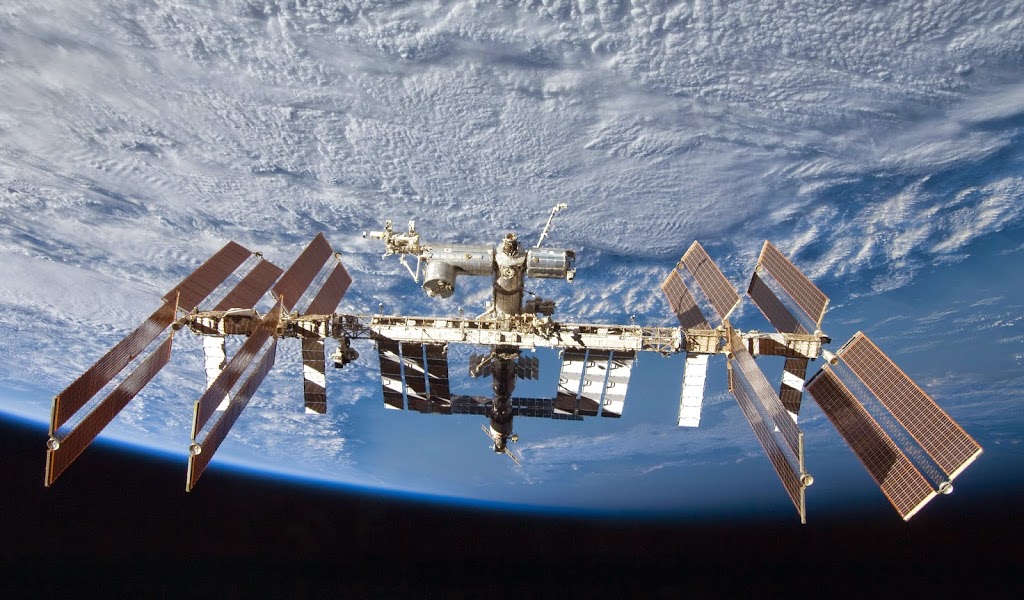
Orbiting space stationWhat are my favorite parts of World War Z? It might raise some eyebrows since I just complained about the cynicism (but remember, I also said a little bit is fantastic), but I love the Paul Redeker story. From the cold-hearted line “The first casualty of the conflict must be our own sentimentality” (Brooks 107), to the twist at the end, I really love that section. On the other end of the spectrum, I really enjoy the parts about movies giving people hope. Then, about halfway through the book, I have a string of favorites–the pilot saved by Mets, who may or may not exist. The castle defense. Kondo Tatsumi and Tomonago Ijiro. Captain Chen’s submarine. The International Space Station–I love learning things about outer space, and it would never have occurred to me to think about people on the space station during a zombie apocalypse. That might be my favorite interview overall. On the other hand, I can’t forget to mention the interview with Father Sergei Ryzhkov, the chaplain who decides it’s his duty to kill the infected, that priests “were the only ones who should bear the cross of releasing trapped souls from infected bodies” (297). That section fascinates me.

I think the greatest strength of World War Z is that it makes you ask yourself, “How would people really react to a zombie apocalypse?” and “What would I do in that situation? Which of these people would I be like?”

I should talk about the zombies themselves, but I’m not sure what to say. They’re zombies. If they bite you, you’re infected and you’ll become a zombie too. The only way to kill them is to blow their brains out. And even though you can trick them into running off rooftops or running into your lines of fire, you can’t fool them into thinking you’re a zombie. Actually, since you know due to the format that all of the interviewees survive the zombie war, that takes away a lot of the tension the undead normally cause. It’s the other humans, and their solutions, that are the scariest part of this book, from the Redeker Plan to the quislings.

I may not have been very interested in the zombies, but I found the quislings very creepy. Quislings are more or less people who would have defected to the invading army, except you can’t defect or surrender to zombies, so “they started moving like zombies, sounding like them, even attacking and trying to eat other people” (156). But it doesn’t work. It just made things worse for everyone else, and the zombies would attack the quislings anyway. In other words, to end on a lighter note, do NOT try this against Brooks’s zombies:


Works Cited

Brooks, Max. World War Z. New York: Three Rivers Press, 2006. Print.