Operation Backlog Completion 2026
Oct 222013
 

I don’t want to give the wrong impression with this post title. I sort of liked Jonathan Maberry’s The Wolfman. Depending on when you ask me, I might even tell you I liked it a lot. I certainly enjoyed the book for a while, but as it got closer to the end, its appeal diminished. I’ll get to that in due time, so there will be spoilers in this post.
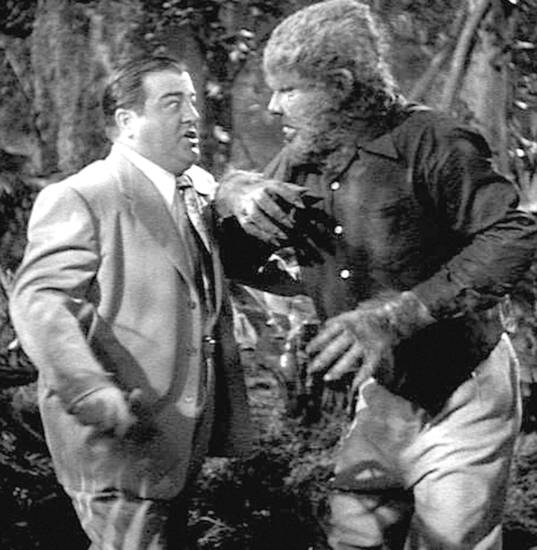
At least it really was Lon Chaney, Jr.

At least it really was Lon Chaney, Jr.

First, though, I’d like to briefly talk about werewolves, wolfmen, whatever you want to call them. Of the classic monsters, I’m the least familiar with them. Off the top of my head, I went into this book most familiar with Angua von Uberwald, Remus Lupin, Chris Jennings, Quentin Collins, and Lawrence Talbot. But don’t get your hopes up at that last one–I haven’t seen the original The Wolf Man movie, either. Instead, I’ve seen Talbot in Abbott and Costello Meet Frankenstein. So if I say anything that suggests I’m missing the point, well, I don’t have as much knowledge about this particular monster.

For example, is there a difference between a “wolfman” and a “werewolf”? Years ago, I thought there was, but more and more I think the two terms are used for the same thing–a man who transforms into a wolf (usually at the full moon). The Wolfman confused me even further about this near the end (spoilers!) when it arbitrarily assigns the name “The Wolfman” to one character and “The Werewolf” to another. I did appreciate that Maberry did something to keep track of who was who in that scene, but it also felt to me like there should be something significant about the names if they were to be assigned that way. It bugged me.

I have not seen the movie that this book was adapted to, so I cannot compare the two. I will say that I’ve read several novel adaptations of movies and games. Sometimes they work really well, and other times it’s painfully obvious that they’re adaptations. This fell somewhere in the middle for me.
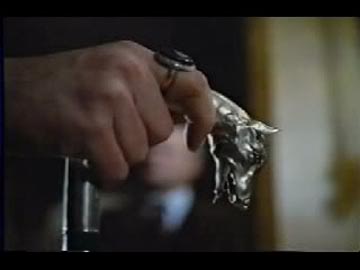
Then again, no one was beaten with it.

Then again, no one was beaten with it.

Back to the story overall, I liked the first half of the book or so. It might have had a slow start, but I liked the mystery and the atmosphere. I also liked that a random Frenchman gave Lawrence a silver wolf’s head cane, because I liked to pretend it was Barnabas’s cane from Dark Shadows. (Since then, I’ve read that the cane was featured in the original Wolf Man movie. I still like to pretend it belonged to Barnabas.) It also was a sword, which made it even cooler. I’m glad it had a role in the plot at the end, because I was starting to wonder if they’d forgotten all about it. It confused me that Lawrence seemed to sense some malevolence from the wolf’s head, but by the end I decided that maybe it was because of his suppressed memories of what he really saw the night his mother died (which would also explain his sense of the moon as “threatening” (Maberry 18). What it doesn’t explain is why the Frenchman had “an enigmatic smile” (24) on his face when Lawrence reacted to the cane, but maybe he’s just familiar with the legends about Blackmoor.

All right, enough about the cane. Let’s talk about the Wolfman itself. It made a good monster–threatening, ruthless, and super-strong. The scene when it ravages the gypsy camp is notable not only because Lawrence is bitten in that scene, but also because it just demonstrates the monster as a majorly destructive force. The later scenes worked in that regard as well. So on that level, the Wolfman is a great monster.

However, I thought a key point of this sort of story was the werewolf character’s guilt and sense of responsibility for the people he kills during the full moon. As a wolf, he is an unreasoning, amoral monster, while as a man, he suffers from the knowledge that he’s dangerous. I expected a lot more of that in The Wolfman than we got. There were a couple of scenes where Lawrence brought it up, and of course we saw Sir John’s method of containing himself in the past (though he’s given that up by the time the story takes place and has become a pretty malevolent werewolf), but it didn’t feel like a central theme. After Lawrence was bitten, more of the focus seemed to be on Sir John as the primary monster, with Dr. Hoenneger and his lackeys as secondary monsters (of the human variety).

My other problem with the second half of the book is that after Lawrence transforms, we aren’t left with anyone to root for. We can root for the Wolfman when it goes after someone like Hoenneger, but not when it goes after innocent people, and it’s hard to feel any connection with an assortment of random innocent people there to be killed by the monster. We can root for Gwen Conliffe, but she only gets a couple of point of view chapters near the end. Maybe we were supposed to root for Aberline, but if that’s the case, it missed me entirely. I didn’t like him.

My feelings on The Wolfman are mixed. I enjoyed many things in this book and found some parts to be handled quite well, especially at the start. But with the lack of emotional connections and the lack of focus on Lawrence’s internal conflict, the last parts of the book felt hollow to me. It might be because it was an adaptation of a movie, but whatever the reason was, it didn’t work for me. At least the wolf’s head cane-sword made a reappearance.

That’s about that, but one thing I want to say before I end this is that I was pleased that the townspeople and Lawrence himself readily accepted the existence of the Wolfman when they saw it. It was a refreshing change from stories where characters persistently deny the supernatural even in the face of evidence.


Works Cited
Maberry, Jonathan. The Wolfman. New York: Tor, 2010. Print.
Oct 072013
 

I just finished reading World War Z by Max Brooks for the second time. I had mixed feelings when I sat down with my copy of the book. My unsigned copy of the book. You see, I first read it about a year ago, for my undergraduate monster class. That November, Max Brooks came to our college to give a talk…and I stayed home. I was fine with that until the next class, when everyone was talking about how great it was, and realized how much I regretted not going.

I’ll never get to see that talk, but at least my college uploaded videos of their hour-long interview with Max Brooks. There’s a lot of great stuff in that interview–he discusses his interest in zombies, his inspirations for the novel, his feelings about the movie, the Walking Dead, and more. Since I know you’re going to go watch the interview after you read this, I won’t rehash all of that. I won’t keep ranting about how I should have gone to his talk, either.

Instead, let me start with a brief word about zombies in general.

Classic zombie from Resident EvilI don’t like zombies nearly as much as people think I do. I have friends who are all, “Hey, Sam, check this out! I bet you’ll love it!” and I go see whatever it is and say, “Okay, so there are zombies. I need to see more than that to be interested.” When I became a Resident Evil fan, it let me to many other enjoyable zombie stories, and I wrote my own zombie fiction. And from then on, people had the idea that I’m a huge zombie fan, which isn’t quite true. Survival horror gameplay and mad scientist stories are more likely to draw me in, and those often come with zombies. I don’t dislike zombies, either. They can be fine monsters. I just wanted to make it clear from the start that I wasn’t automatically drooling over this book because it involved zombies.

Okay, I’ve rambled enough. Back to the topic at hand, World War Z. I liked this book, I really did. It just felt a little too long. I’m not entirely secure saying that, because most of my favorite stories are in the second half. (And that’s really how this book feels to me–not a novel so much as a book of many interconnected short stories, with each interview being an individual story.) The beginning of the book is cool. I love that creepy set-up, with the mounting realization among people that things are really bad. But then there are a lot of interviews that mainly serve to set up the political situation, emphasize how dangerous the zombies are, and demonstrate how a zombie apocalypse would bring out the worst in a lot of people. That’s a common theme in zombie fiction. Your fellow survivors are often scarier than the monsters. A little bit of that stuff is fantastic. Too much, and I feel like I’m being beaten over the head with cynicism. That’s one of the main reasons I stopped reading Karen Traviss’s Wess’Har series. Whenever I get partway through that section of World War Z, I think that I dislike it and that it’s too long…but then I eventually get past that.

Orbiting space stationWhat are my favorite parts of World War Z? It might raise some eyebrows since I just complained about the cynicism (but remember, I also said a little bit is fantastic), but I love the Paul Redeker story. From the cold-hearted line “The first casualty of the conflict must be our own sentimentality” (Brooks 107), to the twist at the end, I really love that section. On the other end of the spectrum, I really enjoy the parts about movies giving people hope. Then, about halfway through the book, I have a string of favorites–the pilot saved by Mets, who may or may not exist. The castle defense. Kondo Tatsumi and Tomonago Ijiro. Captain Chen’s submarine. The International Space Station–I love learning things about outer space, and it would never have occurred to me to think about people on the space station during a zombie apocalypse. That might be my favorite interview overall. On the other hand, I can’t forget to mention the interview with Father Sergei Ryzhkov, the chaplain who decides it’s his duty to kill the infected, that priests “were the only ones who should bear the cross of releasing trapped souls from infected bodies” (297). That section fascinates me.

I think the greatest strength of World War Z is that it makes you ask yourself, “How would people really react to a zombie apocalypse?” and “What would I do in that situation? Which of these people would I be like?”

I should talk about the zombies themselves, but I’m not sure what to say. They’re zombies. If they bite you, you’re infected and you’ll become a zombie too. The only way to kill them is to blow their brains out. And even though you can trick them into running off rooftops or running into your lines of fire, you can’t fool them into thinking you’re a zombie. Actually, since you know due to the format that all of the interviewees survive the zombie war, that takes away a lot of the tension the undead normally cause. It’s the other humans, and their solutions, that are the scariest part of this book, from the Redeker Plan to the quislings.

I may not have been very interested in the zombies, but I found the quislings very creepy. Quislings are more or less people who would have defected to the invading army, except you can’t defect or surrender to zombies, so “they started moving like zombies, sounding like them, even attacking and trying to eat other people” (156). But it doesn’t work. It just made things worse for everyone else, and the zombies would attack the quislings anyway. In other words, to end on a lighter note, do NOT try this against Brooks’s zombies:


Works Cited

Brooks, Max. World War Z. New York: Three Rivers Press, 2006. Print.

Sep 302013
 

There are a few key things that can instantly capture my attention in a story. When I read the first line of Clive Barker’s “The Yattering and Jack” and realized the Yattering was a demon sent out of Hell to torment someone, nothing short of an explosion1 could have torn me away from the page.

The first half of the story made it an instant favorite, possibly my favorite thing I’ve read so far for this course. The Yattering’s fury at Jack Polo for being such an oblivious, unimaginative person made me laugh out loud. It was a perfect setup for a (rather dark) comedy–a demon is sent to drive a man insane, but in the face of every situation, that man shrugs it off with his fatalistic worldview. The Yattering tries everything it can think of, but Jack does nothing more than mutter, “Che sera, sera,2 a phrase he uses “with monotonous regularity” (Barker 44). The first half of the story goes through an account of how things normally go between the Yattering and Jack. The Yattering tries everything. It stops his key from opening the door to his house. It whispers obscene things to him in the shower. It explodes his cats. And through it all, Jack says, “Che sera, sera,” and continues on with his mundane life.

My excitement diminished as soon as the story went to Jack’s point of view. It occurs in the middle of a scene, and we are told that “Jack thought of the game he was playing, and quietly calculated the odds against him” (Barker 50). From there on, it was more of a human vs. the demon plot, and while that was still interesting, I liked the beginning better. I would have enjoyed the story more if we didn’t know for sure until the end that Jack was aware of the Yattering and deliberately fighting it. Not only would that have been a fun twist, but the humor was strongest when it seemed like Jack just didn’t get it. However, for what they were, Jack’s struggles to pretend he didn’t know the Yattering existed, while it did terrible things to him and his daughters, were quite well-written. I enjoyed that part of the story as well. And while I found the ending a little anticlimactic, it was clever and came full circle in an entertaining way.

Let’s discuss demons, starting with the Yattering. It is a fairly traditional demon in that it comes from Hell. It’s bound by specific rules–it cannot harm or touch Jack, and it isn’t allowed to leave the confines of the house. That’s the game Jack is playing with it–if he can drive it crazy enough, it will forget itself and break the rules. The Yattering shows poltergeist-like behavior in its attempts to get Jack’s attention, which even comes up at one point in the story. Of course, because of the rules that bind it, that makes a lot of sense. It can’t touch him, so it touches everything else in the house. At one point, the Yattering decides to beg its superiors to remove it from the situation, and calls upon Beelzebub. Beelzebub is a much higher-ranking demon, and is rather arrogant. He refuses to let the Yattering go, because Jack’s soul is to be theirs. One distinction between the two demons in that scene stood out to me:

The word that followed was anathema. The Lord of the Flies could barely bring himself to pronounce it.
“–Heaven,” said Beelzebub, with infinite loss in his voice.
“Heaven,” said the Yattering, not knowing quite what was meant by the word. (Barker 47)

I found that very interesting. Beelzebub’s sense of “infinite loss” solidifies him as the fallen angel one would expect him to be. The Yattering, however, does not know what Heaven is. It isn’t a fallen angel, it was never in Heaven, and it later uses the word just based on the meaning he gathered from Beelzebub’s use of it. The Yattering is a demon, but of a lesser and different sort. I would have liked to learn more about that.

All right, so remember when I said I found the story less interesting when we got Jack’s point of view? There are two reasons for that. The first is what I said–I thought he was funnier when we didn’t know the truth about him. The second reasons is just that I find demons fascinating, so I was much more interested in the Yattering than I was in Jack.

But, as the title would suggest, this story was about both the Yattering and Jack, and it was a great little piece of demon fiction. And if it wasn’t quite as fantastic as the first half led me to believe it would be, well… che sera, sera.


Works Cited

Barker, Clive. “The Yattering and Jack.” 1984. Books of Blood, Vols. 1-3. New York: Berkley, 1998. 43-64. Print.

1: Or food. Yes, I admit it. I tore myself away from the story for a snack.
2: “Whatever will be, will be.” I had trouble finding where this phrase actually comes from. One of the earliest, or at least most famous, uses seems to be in Doctor Faustus, which makes it even funnier in the context of this story. After all, Jack Polo “wasn’t a Faust: a pact-maker, a soul-seller” (Barker 43).