Operation Backlog Completion 2026
Dec 122014
 

If the Ghostbusters theme song doesn’t give you an impression of what the movie is like, I don’t know what will.

In my undergraduate Monster Lit. class, we discussed how every type of monster found in serious horror literature/film inevitably ends up in a comedy. One of our biggest examples for that class was Shaun of the Dead. To me, Ghostbusters is the ghost/haunting equivalent of that movie–part parody, part homage, wrapped up in an entertaining story.

Ghostbusters takes everything we’ve looked at in this class and puts a comedic spin on it, and that’s where I think its true brilliance lies. Supernatural occurrences, paranormal investigations, spirit manifestations, and possession are all played for laughs. We’ve got a team trying to fight ghosts (taking a much more active approach than the groups in The Haunting of Hill House or Hell House), a building with a terrible secret, and I’ll even give Ghost Story some credit for a change by pointing out that the ultimate antagonist is a shape-shifting force of destruction. The setup works for a straight ghost story, if not for the jokes and general silliness.

Ghostbusters movie caseIt even shares some of the incredible, odds-defying optimism of Scrooge’s redemption in A Christmas Carol. Let’s face it, Venkman and his colleagues don’t exactly inspire confidence as potential saviors of the world. Venkman in particular comes off as a con artist half the time, likable though he may be. The Ghostbusters might have the technology they need, but when it comes to actual plans, they usually make it up as they go along.

Yet it works!

Even when everything seems to be against them, they pull through and come out victorious against the forces of darkness. Considering a majority of ghost stories end in tragedy, the happy ending alone makes Ghostbusters stand out as a lighter look at the genre. And it’s still a ghost story. Its ghosts are even credible threats to the protagonists and the people around them.

All right, but let’s assume you’re reading this not because you care how Ghostbusters fits into the grand tradition of ghost stories, but because you want to know if it’s a good movie. Yes! I love this movie! It’s got a little spookiness, a little adventure, and a lot of comedy. Re-watching it for this class made me laugh out loud a few times. The pacing felt a little off to me (I remembered the ending as being much shorter than it was), but it was still very enjoyable. And Sigourney Weaver is always great.

Now, after everything I’ve rambled about this semester, it wouldn’t be complete if I didn’t get in another video game reference: what’s the video game equivalent of Ghostbusters? The original Luigi’s Mansion, of course! When that game first came out, I couldn’t get enough of it. I still love it (and lament what its sequel did). Until today, though, I never really thought of it as a Ghostbusters reference–but it is! While it serves as its own parody/homage to survival horror games, Luigi’s Mansion is filled with shout-outs to this movie.

The Ghostbusters prepare to fight in this scene from the movie
Luigi's Mansion combat is clearly inspired by Ghostbusters

Of course, horror and comedy are closely linked, so maybe it’s no surprise that everything ends up with a comedy version eventually. And it’s not like I can complain–not only do I love stories like Ghostbusters, but I even wrote my own zombie comedy (which you can get for free from now until January 1, remember) and… comedic Resident Evil and Silent Hill fanfiction…

To Ghostbusters fans, I’d also recommend Jonathan Stroud’s new YA series Lockwood & Co., which centers around a team of young ghost hunters who, like the Ghostbusters, defeat and capture ghosts through a series of disasters.

For that matter, if you’ve searched in vain for a humorous take on demons, where have you been? Neil Gaiman and Terry Pratchett’s Good Omens!

Ghostbusters is a great, funny movie and a wonderful way to end this course. After so many stories about haunted houses, deadly spirits, and possession, it’s nice to end the semester on a positive note:

“I ain’t afraid of no ghost!”

Dec 102014
 

The book cover for Charles Dickens's A Christmas Carol

Even if you’ve never read Charles Dickens’s A Christmas Carol or watched any of its straight movie adaptations, you probably have some familiarity with the story. From use of the name “Scrooge” to describe a stingy or unpleasant person to the dozens of parodies and homages, A Christmas Carol is such a classic there might be more people who know the story without having read the book than there are people who have.

As far as I’m concerned, there’s a reason A Christmas Carol is such a classic. It’s an excellent representation of the Christmas spirit (no pun intended) and repentance. A sour miser who values money above everything (and doesn’t even enjoy it) and never has a kind word for anyone is shown the error of his ways and given a chance to change.

And at the time it was published, it had a strong enough effect on people that donations to charity increased–A Christmas Carol can’t be definitively named the cause, but there’s a good chance it was. If so, it’s also an excellent example of a story that gets a moral point across without sounding preachy or pretentious.

Reading A Christmas Carol for a class on ghosts and hauntings makes me laugh, not because it seems out of place, but because I always think of Ray Bradbury’s “The Exiles,” a short story where the spirits of horror authors are dying as people on Earth burn their now-outlawed books. Charles Dickens is there, and annoyed that he’s been grouped in with the rest of them just because he wrote some ghost stories. (Shakespeare is also present.)

Anyway, back to the topic at hand, A Christmas Carol isn’t as unusual in this lineup of stories as it might first seem. Four ghosts appear across the course of the novel. First, the ghost of Jacob Marley comes to warn his old business partner Ebenezer Scrooge that if he doesn’t change his ways, he’ll be doomed to wander the Earth in torment, as Marley is. Marley appears as a traditional, even cliche ghost, and the book even references it:

A Christmas Carol (1951) - Jacob Marley's ghost

“They were succeeded by a clanking noise, deep down below; as if some person were dragging a heavy chain over the casks in the wine-merchant’s cellar. Scrooge then remembered to have heard that ghosts in haunted houses were described as dragging chains.” (Dickens 13)

(My one criticism of A Christmas Carol is that it’s extremely wordy. A friend once told me Dickens was paid by word, and lines like that make me believe it. Scrooge remembered that he heard that ghosts were described that way? Did we really need all that?)

Of all of the ghosts, Marley is the one most likely to be left out of adaptations, which is a shame, because it’s an excellent scene. It sets the premise for the novel and even contains some moments of humor, such as Scrooge explaining to the ghost why he doesn’t believe in him. Even once Scrooge accepts that it’s real, the two continue to have some entertaining exchanges:

“You will be haunted,” resumed the Ghost, “by Three Spirits.”

Scrooge’s countenance fell almost as low as the Ghost’s had done.

“Is that the chance and hope you mentioned, Jacob?” he demanded, in a faltering voice.

“It is.”

“I–I think I’d rather not,” said Scrooge.

“Without their visits,” said the Ghost, “you cannot hope to shun the path I tread. Expect the first to-morrow, when the bell tolls one.”

“Couldn’t I take ’em all at once, and have it over, Jacob?” (Dickens 18)

The timing of the spirits’ arrival has always confused me, because how Marley says it will happen doesn’t seem to add up with how it’s portrayed in the book–it should take them three nights, yet they get all their visits in on Christmas Eve–but Scrooge basically Hand Waves it by saying spirits can mess with time.

A Christmas Carol (1951) - The Ghost of Christmas yet to Come
All the same, the Ghost of Christmas Yet to Come is spooky.

While these three spirits are more famous than Marley, they aren’t traditional ghosts. The Ghost of Christmas Past, the Ghost of Christmas Present, and the Ghost of Christmas Yet to Come aren’t the souls of dead people, but rather the embodiments of the different times of Christmas.

And as they literally haunt Scrooge to make him change his nature, they also reveal how much Scrooge is haunted in other ways.

He’s haunted by fear of the world, as revealed in the scene from his past where his wife accuses him of replacing his love of her with a love of money. As the spirits show him things, he’s haunted by the past he lost–all of the good things and happiness he once had that he’s so far from in the present.

My favorite adaptation, 1951’s A Christmas Carol starring Alastair Sim (which is where the pictures I’ve used here come from) goes into even more detail regarding the way Scrooge is haunted by his past, such as devoting more time to the death of his sister. But whether you look at adaptations like that or just the original novel, one thing that a lot of parodies and homages miss is that Scrooge is unhappy. He isn’t the Grinch, taking glee in causing others misfortune. He gets no enjoyment out of anything, and that makes him more haunted than just spending Christmas Eve with ghosts.

Of course, A Christmas Carol ends with Scrooge’s complete repentance. When I first read the book, it was for another class, and our professor asked us if we thought it was realistic that a man could change his life completely–and stick to it–just like that. I say yes.

It wouldn’t be realistic if Scrooge changed just after Marley’s warning. But after seeing the way he used to be, seeing all the happiness he once had, seeing the happiness people still have in the present, and seeing the dismal future that awaits if he remains the way he is?

I believe it.

A Christmas Carol is one of the most famous Christmas stories ever, and I believe it deserves that fame. The wordiness of the narrator can get a bit tiresome, but the core story is as wonderful as ever. If you haven’t already read it, you should… or at least watch one of the excellent adaptations.

(Did I make it through an entire blog post on A Christmas Carol without mentioning Tiny Tim? Madness!)


Works Cited
Dickens, Charles. A Christmas Carol. New York: Bantam, 1843. Print.
Dec 082014
 

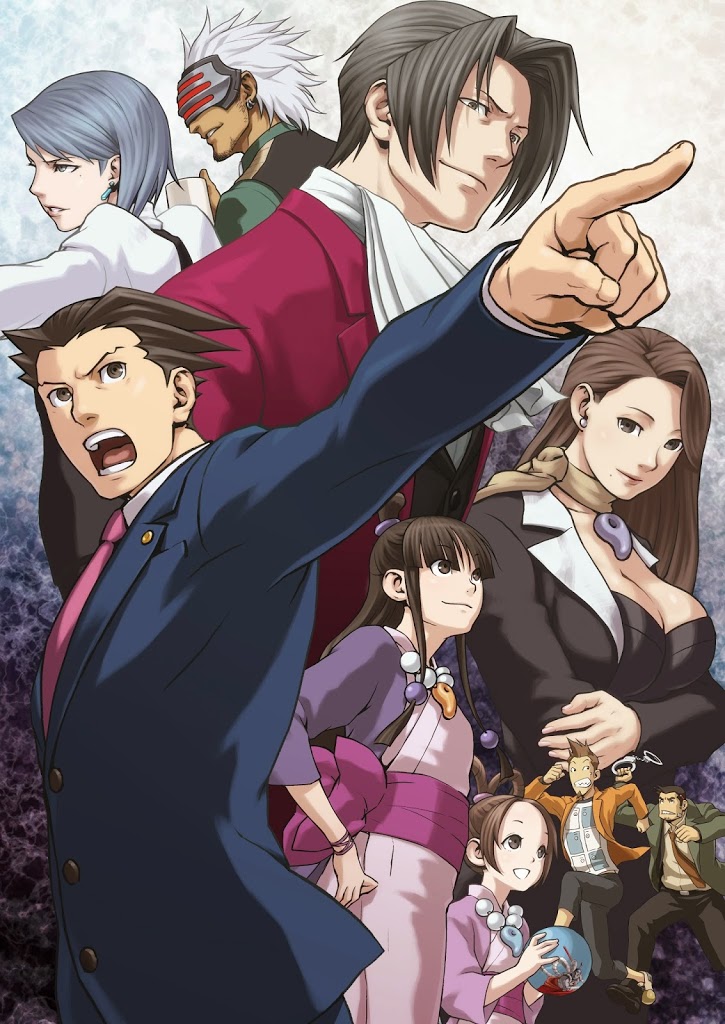
At last, it’s almost here! Tomorrow, the Phoenix Wright Trilogy will be released on the Nintendo 3DS eShop, for $29.99.

If you’ve never played any games in the Ace Attorney series before, or if you’re one of the new players who entered the series with Dual Destinies or Professor Layton vs. Phoenix Wright, this is an excellent opportunity. The original DS versions are still fantastic, but this new release will let you play the first three Ace Attorney games right on your 3DS. (It would be even better if physical copies were available too, but no such luck.) The graphics have been updated along the lines of the iOS port’s graphics, which some fans like and others dislike, and this version is supposed to have smoothed out the animation troubles and glitches the iOS port suffered, while also updating some of the original text to remove typos and errors.

Since Ace Attorney is a story-driven series, I recommend playing them in order. As more time passes after a series has started, that gets harder to do, so it’s great to see the original games coming out again.

The Phoenix Wright: Ace Attorney trilogy contains Phoenix Wright: Ace Attorney, Phoenix Wright: Ace Attorney – Justice for All, and Phoenix Wright: Ace Attorney – Trials and Tribulations. After tomorrow, every Ace Attorney game will be available on the 3DS except for Apollo Justice and the Investigations games.

Since Apollo Justice is a part of the main series, it at least should find its way to the 3DS. Here’s hoping for a follow-up collection containing Apollo Justice, Ace Attorney Investigations: Miles Edgeworth, and… a localized Ace Attorney Investigations 2?

I can dream!

Are you planning to pick up the Phoenix Wright Trilogy? Would you love to see an AJ/Investigations bundle? Share all your thoughts in the comments below!