Operation Backlog Completion 2026
Nov 142014
 

As you probably know, I was pretty dissatisfied with The Amityville Horror. I was willing to cut it some slack because it was presented as a true story, and even if it’s a fraud, it had a “here are the facts” style that didn’t work well for a horror story. Well, I’m not sure I should even give it that much credit. You see, the next book I read for class is also supposed to be a true story. Elaine Mercado’s Grave’s End is a better story than The Amityville Horror in every way.

I’m a skeptic when it comes to ghosts, but I’m much more willing to give this book the benefit of the doubt. For one thing, I just enjoyed reading it as a book.

Due to the nature of the book, I knew going into it that the protagonist would survive–she’s the author, after all. Maybe because of that, I can’t say it ever really scared me. On the other hand, it made me care about the characters. I liked Elaine and her daughters and wanted to know what was going to happen to them. I wanted things to work out and wanted them to be happy. That is one of the key things The Amityville Horror was missing, and I thought it was because the author was writing about real people instead of crafting characters. Well, Grave’s End proved to me that it doesn’t have to be that way.

The ghostly elements were also presented in a much better way. A lot of different supernatural events happen in this book, but they had consistency. Yes, some were unrelated, seemingly random events unconnected to the main plot, but it worked. It let me suspend my disbelief and accept this strange house where creepy things happen.

Best of all, it had resolution. By the end of the book, they know what caused the main hauntings. Prior to that, the characters’ research revealed details that gave meaning to some of the sightings and events. This way, it felt like a ghost story (enough to remind me that I really need to get back to playing Fatal Frame). Pieces of the mystery were gradually revealed, and then the final revelations occurred with the “cleaning” at the end. The big revelation is pretty interesting, too. In a dark, morbid sort of way, I loved it.

Not every question was answered, and some of the answers weren’t satisfactory–but what really delighted me was that Elaine commented on these things. They weren’t just thrown at me in a “that’s just how it is,” way. Instead, I felt her uncertainty and doubts even as I felt my own. That’s great, and I can’t think of a better way to write a true account where things don’t neatly come together in the end.

One thing did bother me, though. (And this relates to the ending, so if you haven’t read Grave’s End and intend to, this is a spoiler!) Near the end, Karin is pretty upset that the medium “cleaned” the house instead of just communicating with the spirits. She felt they should have been asked if they wanted the supernatural activity to stop or not. The only counterargument really brought up was that the events were scary and Elaine assumed getting rid of them was the right thing to do. Why didn’t anyone mention that the ghosts wanted to move on? They clearly weren’t happy, and the medium even said that they “want to go” (Mercado 151).

Other than that minor issue, I liked this one. It’s believable as a true story, and even if it’s false, it’s a good read as a ghost story. Every place where The Amityville Horror failed, Grave’s End succeeded. My faith in nonfiction ghost stories is restored.


Works Cited
Mercado, Elaine. Ghost’s End: A True Ghost Story. Llewellyn Publishing: Woodbury, 2001. Print.
Nov 052014
 

As you might know, I don’t believe in ghosts. I’m willing to give real life ghost stories the benefit of the doubt, though, and since I do believe in the Devil/demons, I can believe The Amityville Horror is a true account.

That poses a problem. I can’t review a documentary-style book in the same way I would a fiction story. I can’t fault the author’s characterization or the consistency of the plot. Now, there is some controversy about whether or not these things really happened. I didn’t do extensive research, but Wikipedia lists several criticisms, including outright claims that it’s a fictional story.

In fact, I learned in my class that the Lutz family even admitted it was a hoax once.

Still, it presents itself as a true story, so as I read it, I tried to view it as if it was one.

My feelings toward this book would be much less positive if I didn’t go into it with that attitude. I never really grew attached to any of the characters or got a good sense of characterization, and I didn’t feel a sense of immediacy about the plot. Rather than experiencing the story (as you do with a good book), I felt like the story was being told to me. That all ties in to the lack of horror I felt while reading it. Although reviews described The Amityville Horror as terrifying, the fear seems to hinge on your belief that these things actually happened. It’s scary to think that such things are real and could happen to anyone–even you. As a story, however, it failed to scare me.

Books can be terrifying, but only if they pull you in. My lack of investment in the characters and plot left me with no dread or tension.

More than anything, the scares irritated me because of how the author handled them–exclamation points. Lots and lots of exclamation points. Now, I like the occasional exclamation point here or there, but it just tied in to my feeling that I was supposed to be scared merely because the events were real. Even if this was an account of true events, I wish the author would have put a little more care into each horrific revelation.

Still, there’s a positive side to everything. This book was the proof I needed that littering my passages with exclamation points really is a bad idea. H. P. Lovecraft can get away with it, as his characters frantically scrawl down their final terrified thoughts while dying, but it doesn’t work for everyone.

I’d love to critique its plot, but again, I’m limited because of its nature. I wanted to know what forces were at work in the house. I wanted to learn the dark details of the secret room and what it was once used for in the past. I wanted to understand why the various supernatural events were all so random, since the events felt more like a collection of spooky encounters rather than a cohesive story. If it’s a true story, though, my objections fly out the window. Why did these things happen? Because that’s how they happened. Why don’t we get more details? Because the other details aren’t known.

Of course, if it’s a hoax… I could give them the benefit of the doubt and say that a believable hoax can’t be wrapped up as neatly as a fictional story, but still, I can’t help but wonder if they just plotted out their hoax badly, or didn’t care enough to pay attention to the details.

With all that said, what’s up with the cliffhanger ending? I like it… from the perspective of a fictional story. From the documentary perspective, were we supposed to believe the Lutzes really were haunted after they left the house, or did the author just think it would be a cool twist?

I feel like my thoughts on The Amityville Horror are scattered and rambling, and that’s because I really didn’t feel anything for this book at all. At least I hated Ghost Story, at least I could pin down my issues with The Others

I left The Amityville Horror feeling apathetic. It wasn’t very good, it wasn’t very bad, and I could cut it some slack if it was real, but if it’s a hoax, I wish it had been at least a better story.

Oct 152014
 
Book cover of The Shining by Stephen King

Yes, that’s right. I never read a book by Stephen King until I started The Shining for class. I had a very vague familiarity with it, but I didn’t know most of the details (basically I knew the movie adaptation had Jack Nicholson with an axe, and even then I wasn’t positive I had the right title), and I definitely didn’t know it was a ghost story.

I also had no clue what the title meant, so I found that pretty interesting. I never would have guessed it referred to psychic powers.

So, I wasn’t sure what to expect from this novel, but once I got into it, I liked it a lot. Unlike the last book I read for class, The Shining had genuinely disturbing moments. By the end, I was anxious and distressed, and I finished the rest of the book in a single sitting so I could find out what happened.

The Shining centers in on one of my favorite horror techniques–a character’s gradual descent into insanity. (There’s a reason H.P. Lovecraft is my favorite horror author.) Or… maybe it was about possession. That’s another one of my favorites. It might be a mixture of the two, and it does provide some ambiguity about how much of the madman at the end was Jack Torrance and how much was the Overlook Hotel. If possession, it’s not a rushed takeover, but a gradual, subtle technique… finding his vulnerabilities and picking away and his defenses to bring out his inner darkness.

The Overlook Hotel is another living place, like Hill House and Hell House. It directly references the first in one of its most striking personified moments, as Jack thinks:

“The Overlook was having one hell of a good time. There was a little boy to terrorize, a man and his woman to set against one another, and if it played its cards right they could end up flitting through the Overlook’s halls like insubstantial shades in a Shirley Jackson novel, whatever walked in Hill House walked alone, but you wouldn’t be alone in the Overlook, oh no, there would be plenty of company here.” (King 414)

And said “company” drew my thoughts right along to Matheson’s Hell House. Both houses appear to have remnants of their old, corrupt inhabitants lingering around. The ballroom/party where Jack sees Derwent, Grady, and the others reminded me of the scene in Hell House where Edith is tormented by specters of the people who once gathered there. Although we never learn a lot about Derwent, it was easy to imagine him as a Belasco figure.

Of course, if we’re talking about places that are alive, how can I not reference my favorite horror town, Silent Hill? While Silent Hill doesn’t drive its visitors to do terrible things (even Walter Sullivan was twisted by the cult, not the town itself), it digs into their minds and mixes their pasts with the town’s own history.

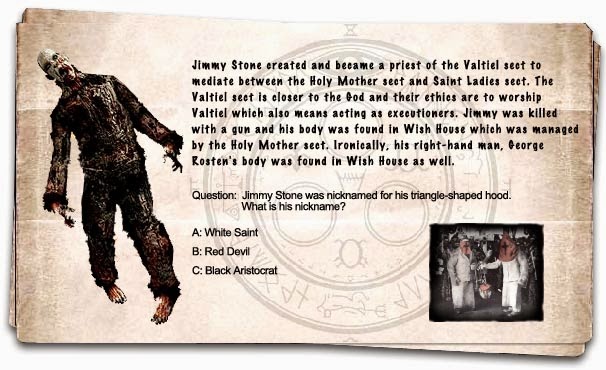
Silent Hill's Jimmy Stone, with a picture of him as the Red Devil

Pyramid Head came from James’s mind… with a little inspiration from the cult.

The Overlook is much more malevolent, but it does just as good a job at mixing Jack’s past with the hotel’s past and even the play he’s working on.

Only two things disappointed me about The Shining. First, I thought the George Hatfield incident was going to have more relevance than just being another dark moment in Jack’s life and the reason he needs a job. Second, there were some scenes where I felt Jack went back and forth a little too much. I enjoyed his struggle between staying true to himself and falling prey to the Overlook, but a few times he switched sides so often in such a short period of time, it felt repetitive.

Otherwise, I enjoyed the novel. It balanced the supernatural and psychological horror aspects quite well, and I recommend it to anyone who enjoys those types of stories.


Works Cited
King, Stephen. The Shining. New York: Anchor Books, 1977. Print.