Operation Backlog Completion 2026
Oct 172014
 

Cover for Fragile Dreams: Farewell Ruins of the Moon (Wii)Fragile Dreams: Farewell Ruins of the Moon isn’t actually a horror game. This somewhat obscure action-adventure RPG was released for the Wii in 2010 (it came out first in Japan in 2009) to a mixed reception.

Despite its genre, and a story that eventually takes on definite science fiction elements, I have yet to find a game with an atmosphere that better fits the description of “Silent Hill for kids.”

You play as Seto, a teenage boy searching for other survivors in a post-apocalyptic world. (You don’t learn much about the apocalypse until the end of the game.) The environments are eerie and haunting, filled with a deep loneliness that mixes with fear as you encounter ghostly enemies. You’ll level up as you fight, but the clunky combat ensures you never feel quite safe enough, as it’s difficult to aim at and hit enemies.

Weapons break through repeated use, the Wiimote is used to control your flashlight, and limited space in your inventory means you have to choose your items carefully. Campfires are scattered through the world, where you can manage your inventory, save, buy stuff from the (really weird) merchant, and look at mementos.

he Merchant from Fragile Dreams: Farewell Ruins of the Moon

The Merchant

Mementos add an intriguing bit of storytelling to Fragile Dreams. Each one contains a fragment of a person’s story, some of which are connected. By providing little bits and pieces to flesh out the world, it told its story in a style very reminiscent of survival horror.

The game does have its flaws. Some people may find the combat more frustrating than challenging, and the enemies are repetitive. If you like ambiguity in your stories, you’ll love this. If you don’t, you’ll probably be grinding your teeth by the end. Fragile Dreams’s ending (no spoilers, don’t worry) answers some questions and raises others.

The more I think about it, the more I feel its story also demands a comparison to the Professor Layton series, although much darker and lonelier, and without puzzles.

Ultimately, it’s a story about relationships and emotion, set across a series of beautiful environments as you search for the mysterious silver-haired girl you caught a glimpse of. It’s a short game, lasting around 15 hours, slightly longer or shorter depending on your gameplay style.

It’s not for everyone, and this isn’t your place to turn if you want something terrifying or action-packed. But if you’re interested in a slow-paced game with a strange and haunting story, an RPG with light survival horror trappings, or a creepy game to play for Halloween that isn’t actually horror, you should really check out Fragile Dreams: Farewell Ruins of the Moon.

Also, it has beautiful music.

And cat toys, so you can play with cats wandering through post-apocalyptic Tokyo.

Have you played Fragile Dreams? I know there are some of you out there. Let me know your own thoughts and impressions of this obscure little game.


Buy Fragile Dreams from Amazon
Buy Fragile Dreams from Play-Asia

Oct 132014
 

Silent Hill 4: The Room might be criticized by some Silent Hill fans, but that’s nothing compared to the survival horror game I want to discuss today.

Video game Amy's cover image

VectorCell’s Amy was thoroughly trounced when it was released for the PS3 and Xbox 360 in 2013. Its Metacritic scores for the two versions are 33 and 25 respectively, and some critics actually gave it a score of zero.

So why on Earth am I celebrating it? Because I actually enjoyed it.

I played it after the developers released a patch, a patch that fixed the most grievous issues the original version had (most notably, game-breaking glitches) and improved the checkpoint system. So, to be completely fair, the version of Amy I played was not the exact same game that received such awful scores.

You play as Lana, a woman accompanied by an autistic girl with psychic powers, Amy. The two are trapped in a city that has been overtaken by an infection, and have to escape while being hunted by the zombie-like monsters the citizens have become. Lana herself becomes infected, but the symptoms are staved off as long as she remains near Amy.

The idea has great potential. You need to protect Amy, and there are times when the two characters have to split up to solve puzzles and progress, but you can’t remain away from her for too long or you’ll die.

Potential is what the game has the most of. Some aspects are legitimately fun, like using Amy’s powers to start a car alarm and distract the nearby enemies. The final battle was also very cool, as well as intense. I was disappointed, however, that her power wheel was never filled. It was as if VectorCell held back on some things in order to make room for the sequel… which will probably never exist.

The rest of the gameplay is a mix of survival horror and stealth. This has some good points, such as avoiding broken glass to not alert enemies to your location, but it never felt like it was fully utilized. Hiding, especially, seemed most useful only during scripted encounters.

Even with the patch, Amy has definite flaws. Any items you collect can’t be carried over to the next chapter–except in one chapter. When that chapter broke gameplay rules, I was stuck for a long time, and annoyed when I found out what happened. It relies on checkpoints and auto-saves, which I typically dislike. Its story feels only half-finished, again most likely because of the planned sequel. And it never quite fulfills its potential.

Amy isn’t a perfect game by any means, but… well, let’s put it this way. I chose to play it instead of the Resident Evil 6 demo. Does that say more about Amy, RE6, or me? Either way, if the developers ever ventures into the world of survival horror again (though VectorCell itself has closed down), I’ll be happy to try out their next game.


Buy Amy from Xbox Live
Buy Amy from PSN

Oct 102014
 

Let’s continue our celebration of spookiness by taking a look at one of my favorite survival horror games. Silent Hill 4: The Room is not widely considered to be one of the best Silent Hill games, but it’s actually the one I like the most.

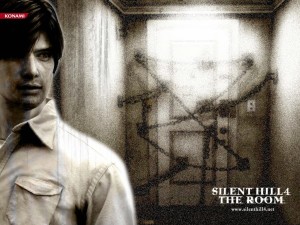
Official art for Silent Hill 4: The Room

As you might know, I got into the survival horror genre because of Let’s Plays. I was convinced I wouldn’t like horror games, but my friend talked me into watching her Let’s Play of Silent Hill: Shattered Memories. You know what? I really liked it. I went crazy trying to figure out what was going on in the story, and when it was all over, I missed it.

So I found other Let’s Plays of the rest of the Silent Hill series, and of all of them, I liked the fourth game the most–so much so that I needed to play it myself, and thus I bought and played my first survival horror game.

(I played the Xbox version because it was less expensive. Silent Hill 4 is one of those Xbox games that works on the Xbox 360 with just a few issues, in this case weird graphical problems like lines on characters’ faces. The gameplay was perfectly intact. The PC version, on the other hand, has notoriously terrible AI.)

Unlike most games in the series, Silent Hill 4 doesn’t begin with the player entering the town. Instead, you wake up in an apartment in South Ashfield, a city near Silent Hill. The apartment is sealed. The doors and windows won’t open, the phone doesn’t work, and no one can hear you when you shout. When a strange hole opens up in the bathroom, it looks like your chance to escape, but it leads you to a strange version of the nearby subway station…

The apartment, Room 302, acts as a hub area, where you can save, store items, and heal before returning to the various Otherworlds. It’s also viewed in first-person, although the rest of the game has a third-person view. Rumor has it the game wasn’t originally meant to be a part of the Silent Hill series, but the decision was made very early in development (so don’t use that as a reason for disliking it).

Objectively, I’ll admit Silent Hill 4 is not the best Silent Hill game. That title probably goes to Silent Hill 2. But something about it just appeals to me, even if its protagonist is, well…

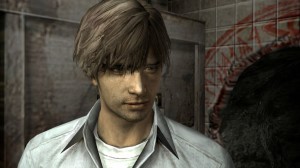
Henry Townshend from Silent Hill 4

This is his happy face.
And his sad face.
And his terrified face.

Poor Henry Townshend gets a lot of criticism for having next to no emotional range, responding to nearly every situation with, “What… the hell…?” and asking a blood-soaked dying woman if she’s all right. But the thing is, Silent Hill 4 isn’t about Henry, not really. Sure, from the player’s perspective, the entire game is about helping Henry escape from his apartment. But what does the gameplay really do?

It sends you to twisted locations in both Ashfield and Silent Hill to discover the events of their pasts, gives you clues as to what happened in Room 302 and to its former occupant, Joseph Schreiber, and forces you to piece together a story about a little boy, a cult, and a serial killer.

From its plot to its symbolism, Silent Hill 4: The Room is about Walter Sullivan.

Even the title, The Room connects back to Walter. Sure, it’s Henry’s room that he’s trying to escape from, but the room itself is at the center of Walter’s obsession. It may begin as your sanctuary and safe place, but it gradually falls under Walter’s sway…

And he’s always watching you.

Walter Sullivan is one of my favorite villains, and he’s really the reason I started writing fanfiction. (Although my writing has improved a lot since then, so I cringe to even look at my original Silent Hill 4 fanfiction.) His dual nature as both this scary villain and tragic victim resonated with me when I watched that first SH4 Let’s Play, and it still does now. He’s the sort of villain you wish you could help, even though you know it’s too late.

Silent Hill 4’s symbolism is often criticized, because it has virtually nothing to do with Henry. Henry isn’t the James Sunderland of this story, Walter is. The Otherworld, the monsters, and every other piece of symbolism in the game connect strongly to Walter’s story, just as strongly as Silent Hill 2’s symbolism connects to James. In fact, I’d argue it’s much stronger than Alessa’s symbolism ever was, although that could be because Silent Hill 4 takes place in an Otherworld created by Walter through a ritual, rather than in Silent Hill proper.

Speaking of rituals, I love the cult. I have a slight bias toward Silent Hill games that involve the Order of the Halo of the Sun in some way. Cults are frightening, and their involvement lends credence to the idea that even in Silent Hill, humans are the real monsters.

Two more things are sometimes brought up as flaws of Silent Hill 4–the invincible ghosts and the escort mission. I have no problem with either of these. Invincible ghosts just add more tension, especially when one starts chasing you. As for the escort mission, it isn’t the kind where you fail if the person dies. In fact, it’s impossible for her to die during the game. Your success or failure at protecting her when she’s with you is tied to how difficult it is to get the good or best ending. It even sets up a pretty neat risk/reward system, as you need to decide if you should arm her, which helps you take out monsters but also puts her in more danger. Great stuff!

So, as we look forward to a new Silent Hill game and other great survival horror games, I think back to how it all began for me. I still love Silent Hill 4: The Room. Give it a chance. You won’t be sorry.

What’s your favorite Silent Hill game? Vote and share your thoughts on Silent Hill 4: The Room in the comments below!


Buy Silent Hill 4 from Amazon
Buy Silent Hill 4 from Play-Asia