
For years, friends have bugged me to play the Tales series. Usually Tales of Symphonia, but other titles have come up from time to time. A big-name JRPG series, well worth my time to check out… but I never quite got around to it. I finally gave the series a chance when I won a copy of Tales of Xillia.
I actually finished it back in October, but since my focus was on horror, I decided to save my review for this month.
(This post contains light spoilers, since I’ll be discussing my favorite character, but nothing visible contains anything major.)

Tales of Xillia gives you the option of following two protagonists: Jude Mathis or Milla Maxwell. The story is largely the same either way, but certain scenes and sections differ depending on who you play as. I heard the story is harder to follow if you play as Milla, so I picked Jude.
For a lot of fans, Jude might be the weakest part of Xillia. He’s a fairly dull protagonist. No matter whose story is clearer, the plot focuses on Milla’s quest, and Jude spends a good portion of the game just wanting to help Milla. That said, it raises some interesting comparisons between Jude and another member of the cast, which I won’t go into because it involves heavy spoilers.
One thing that made Tales of Xillia stand out to me was its sense of humor, and that’s where Jude takes an especially good role in the story. Now, I hated the two most obvious comic relief characters (Ivar and Teepo), but beyond those annoyances, the game was quite funny at times… often at Jude’s expense.
The gameplay was enjoyable. I prefer turn-based RPGs, but action RPGs are fine and Tales of Xillia handled it well. I never used Jude’s evade attack, and I barely played as any other characters, but I loved using the Link System and trying to chain multiple Linked Artes together. I ignored the food system for a while because… uh… I forgot about it… but once I actually started using it, I liked that too. I’d load up on food that increased gald and experience earned from battles, and use one after the other to get as much out of them as possible–I especially tried to time it to make sure they were in effect for boss battles.
And speaking of experience and battles, the leveling Lilium Orb system reminded me a bit of Final Fantasy X’s sphere grid. While FFX isn’t my favorite Final Fantasy games, it’s one of the few where I would level grind just for the fun of leveling up.
Instead of a typical RPG shop system, where you buy better items at locations further along in the game, all of the shops in Xillia can be leveled up by donating gald (the game’s currency) or materials. As a shop increases in level, new items become available and other items are discounted. I enjoyed this little twist.
The story was pretty interesting, with twists and turns, but what made it notable to me is that it sidesteps and subverts a lot of typical fantasy and/or JRPG story elements. For example, fantasy stories tend to depict two types of kings: the scary conqueror king and the good king who takes the time to talk to each and every one of his citizens. Tales of Xillia has Gaius, who manages to be both.

Aw, if his people love him so much, he must be such a nice–EEK!
Gaius is my favorite character from Tales of Xillia. This guy is so cool, there are NPCs who talk about how awesome he is and it doesn’t feel forced. His #1 priority is protecting his people, and if you hurt them, you’re going to suffer the full wrath of a king who will lead his army against you and possibly wipe out most of your forces by himself.
He also bumped Zacharias Barnham (PL vs. PW) and Simon Blackquill (Dual Destinies) from their top spots on my “hottest video game guys” list.
Speaking of which, we need more Gaius pictures. Fellow Gaius fangirls, this is for you.
(Hidden because of major spoilers and to spare any mortified non-fangirls reading this.)

And his “Absolute Domination” Mystic Arte was awesome enough normally…
But in the final battle…
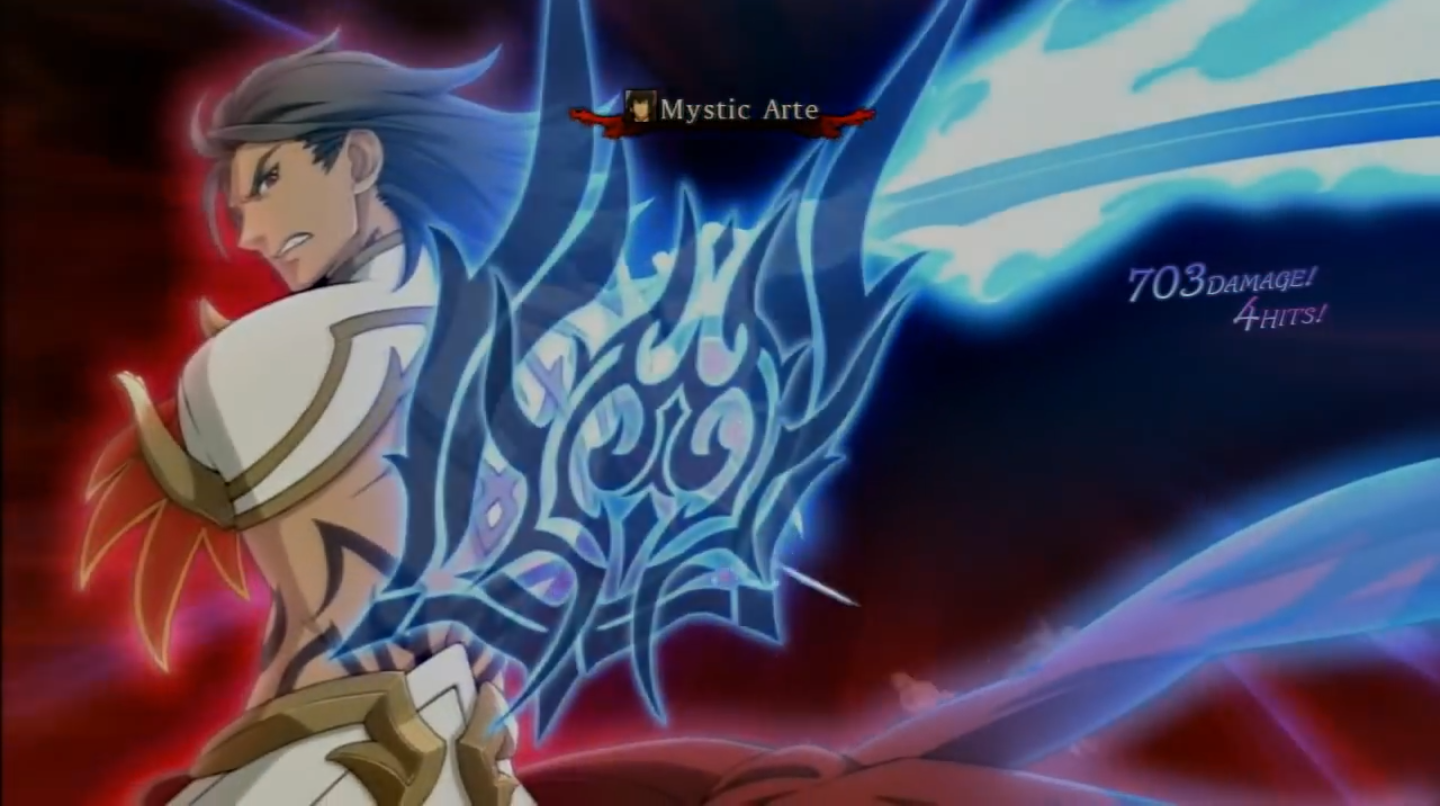
Even more awesome!

And he’s dominating away…

Staring into your soul…

“ABSOLUTE DOMINATION!”
I really wish these images were better quality… 😉
But at least I have a Tales of Xillia 2 Gaius poster!

Don’t give me that look! Being attractive doesn’t make Gaius any less of a strong, fascinating character!
Moving on…
I found the majority of the characters to be interesting in their own ways, and I enjoyed exploring the world. There was a lot of treasure and loot to collect, and the collector in me wasted a ton of time at the beginning because I just wanted to fight monsters and pick up stuff.
I only have a couple of complaints. Near the end, it felt a little rushed, and a couple of subplots were never expanded on to my satisfaction. It also disappointed me that the story’s major moral conundrum is neatly resolved without any real effort. Not that I wanted it to end with a choice between two bleak possibilities, but I wanted them to work a little more for their happy ending instead of just being handed a convenient third option.
Overall, Tales of Xillia was a fun experience. I’m sorry it took me this long to get into the Tales series, but now that I’ve made it, I’m going to stay. I’ll definitely play Tales of Xillia 2, and since I already have Tales of Symphonia Chronicles and Tales of Destiny, I’ll play those as well.
Join me in the comments to discuss Tales of Xillia and the series further! Which games do you recommend the most? What did you think of Xillia and how does it compare to the others? Have I lured in any Gaius fangirls?
Buy Tales of Xillia from Amazon
Buy Tales of Xillia from Play-Asia
 The last time I watched a movie for class, the ending destroyed what was otherwise a fairly entertaining story, I mentioned that endings matter. Now I’m going to talk about how motivations matter, because when I finished Paranormal Activity, the biggest question I had was “why?” (There will be spoilers in this post.)
First: why is Micah such a jerk?
Not only do character motivations matter, but characters themselves matter. It’s okay to have some jerks in the cast, but it’s nice to have likable protagonists, especially if you want the audience to care about what happens to them. I didn’t like Micah. At all. He started out annoying, then he became a total jerk, and as more supernatural stuff happened, he just got worse and worse. It was hard not to feel like he cared more about getting some awesome paranormal footage and/or proving he’s the big macho man who can punch out a demon than he cared about Katie’s well-being… or his own.
Micah makes the husband in Grave’s End look like a saint. At least that guy started out as a skeptic and then goes into denial. I can feel some sympathy for the apparent idiocy of a character who really doesn’t believe anything supernatural is going on.
But Micah?? At first, there are a few shades of skepticism to him, and it’s implied he doesn’t really believe Katie or take her seriously. That ends pretty fast. Before long, he convinced there really is some sort of demonic entity in the house, yet he still doesn’t take it seriously. He:
- Refuses to let Katie call the demonologist because he’s so arrogant he thinks he can take on the demon himself.
- Decides a Ouija Board would be the best way to communicate with the being even after the paranormal investigator specifically warns him not to try because it’ll open the door and make things worse.
- Taunts the demon for not doing anything too bad. (I’ll get to the demon’s motivations in a little bit, but seriously, if you’re haunted by a demon that just likes to turn on faucets, open doors, and stomp around… be happy. What kind of idiot gets upset that things aren’t worse?)
- Keeps the camera on constantly for no clear reason except that he really likes to use the camera. (While insisting this will somehow help the problem… because having your demon on tape will be useful when you refuse to call in anyone for help.)
- Brings a Ouija Board into the house despite the previous warning and promising Katie he wouldn’t. (As soon as he promised he wouldn’t buy one, I knew he was the sort of nitwit would would take the exact wording as an excuse to borrow one.)
There’s more. I’m sure of it. Micah spends the entire movie being an unlikable jerk, which would be bad enough if their lives weren’t at risk. Even toward the end, he’s not really taking it as seriously as he should.
In short, I wanted to punch Micah for most of the movie, and kinda hoped he would get first-hand proof of how dangerous the demon was, so the movie didn’t exactly make me concerned for this character’s welfare.
But at least I was concerned for Katie, which brings me to my second “why.” Why does she always cave to Micah? She seems to realize he’s a raging idiot, yet even after she makes him promise to abide by her rules when it comes to the camera, the footage goes on pretty much as it did before, so…. what was the point of that?
She gets mad when she sees him with the Ouija Board, but she didn’t really take any steps to get it out of the house, despite knowing the danger. She just orders Micah to get rid of it. Because he’s proven so reliable in the past.

Reverend Trask would have livened this movie up.
Katie finally takes some positive action when she decides to call the demonologist, but when he’s unavailable and the investigator from earlier says he can’t help, she just gives up. She doesn’t look up another demonologist or call a priest or anything. And when Micah reads stuff on the Internet that says an exorcism might make things worse, she just accepts it.
She’s a passive character, one who always reacts to the actions of others. In a way, this reminds me of Vicki from Dark Shadows (the TV show, not the movie), but at least Vicki was surrounded by a cast of proactive characters. All Katie has is Micah.
And the demon.
This question of character motivations doesn’t just end with the human characters. My third “why” is why does the demon do the things it does?
I complained that the events in The Amityville Horror felt random and disconnected, and I praised Grave’s End for having a neat explanation for the central supernatural activity. Even The Others has a solid reason for why the “ghosts” in the house do the things they do. Paranormal Activity lines up more with The Amityville Horror in that the demon’s motivations are even less understandable than Micah’s.
Assuming its ultimate goal was to possess Katie… why did it do most of the things it did? Did it need her to be at a certain level of fear? Was it amusing to the demon to flicker the lights or make loud noises? Did it pinpoint Micah as just the sort of moron who would ignore the expert and bring in an Ouija Board… which it could then conveniently leave a message on even though Micah never actually used the board, and write what may or may not have been “Diane” (or… Di-anne, since he said there were two Ns) in the hopes that Micah would do the exact Google search needed to find the demon’s previous victim and therefore not call an exorcist?
Even if the demon did use an insane Batman Gambit like that, why did it want them to find the photo in the attic? Why did it spend the first part of the movie going upstairs in the dark, then decide it needed the light on? Why did it develop a shadow partway through?
And why, since it clearly understood what the camera was, didn’t it try to stop the filming? Did the demon just really want to be a star?
Outside of all these complaints, Paranormal Activity wasn’t all bad. The “found footage” style lent it a sense of realism which annoyed me at first but gradually increased my immersion. There were a few genuinely creepy moments and some good scares.
But I doubt I’ll watch it again.
This is a strange feeling. On Saturday, we hit the halfway point for NaNoWriMo. This is the blog post where I should give you my word count and tell you how things are going with my current project. I should discuss my progress so far and what I need to do to finish in time. That’s what I did last year, after all.
This year, things are a little different. The goal of NaNoWriMo is to reach 50,000 words by the end of the month. On the 15th, the halfway point, I…crossed 50,000 words.
According to NaNoWriMo, my average word count has been about 3400 words a day. For the first few days, though, my word counts were well below that. I also take Sundays off. What it really comes down to is that I’ve started writing around 4,000 words a day, sometimes close to 5,000.
How? A few years ago, I’d have given anything to learn how to write 4,000 words a day. Sure, I had some great writing days back then, but nothing consistent.
My Vague Guide on How to Write 3,000-5,000 Words a Day
First, I’ve given myself a structure to follow. When I just go through the day, writing a little bit here and there whenever I feel like it, it’s hard to get a lot written. And I’m not a big fan of scheduling my writing. I’d much rather do it when the mood hits me. For this NaNoWriMo, however, I started attending morning chats with other writers from my Seton Hill University Writing Popular Fiction program. That forces me to spend a specific block of time each morning writing. I don’t have time to do anything else.
And I’m not even tempted to waste the time during the chat, because we do writing sprints.
Writing sprints, word wars, whatever you want to call them, a little bit of competition goes a long way. It’s not so much wanting to write more words than other people as knowing that when the timer goes off, you have to show your word count to a bunch of other people. It makes you accountable, and it makes you try your best.
Next, I type fast. It’s hard to get around that one. Speed makes large word counts a lot easier to get. I never really thought about my typing speed until I started doing these writing sprints, but now it’s noticeable. We do 20-minute sprints, with breaks in between. On average, I get around 1,000 words written each sprint.
I stay for 4 sprints and end the morning around 11 o’clock with 4,000 words already written. If I want to bump that up a little further for the day, I just need to work some writing in like I would have otherwise.
One other, important element…
I really love my story this year. I mean, I love my story. Even if you can type fast, you’re holding yourself accountable, and you’re setting aside specific times for writing, it’s hard to turn all that effort into high word counts if you can’t come up with the ideas fast enough. That’s been my challenge in the past–using the time I’m not writing to figure out what’s going to happen next.
It isn’t a problem this year. I find myself thinking through the next few scenes all the time. New events just pop into my head. Writing this story isn’t a chore, it’s entertainment. I have to remind myself there are other things I need to do, so I can’t spend all day working on it. I love my characters, and I want to see their story through to the end.
And that’s just what I’m going to do.
NaNoWriMo ends on November 30. Even though I already have my 50,000 words, I’m not ending here. For me, a new NaNoWriMo challenge has presented itself: finish the first draft of this novel before the end of the month!