
Jan 122026
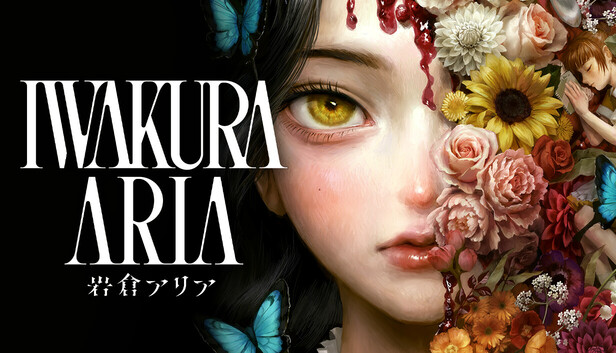 Near the end of 2024, PQube announced that they’d be publishing Iwakura Aria, a visual novel that caught my attention for how hauntingly beautiful it looked.
(And because the trailer had House in Fata Morgana vibes.)
Anyway, Iwakura Aria came out last year, and I eventually picked it up and played it as my first game of 2026.
Set in 1966 Japan, it follows a girl named Ichiko who gets a job as a maid working at the strange Iwakura mansion, where she’s quickly enchanted by the owner’s beautiful daughter, Aria. The story focuses on two main things: the blossoming romance between Ichiko and Aria, and the mysterious hints of disturbing secrets in the mansion.
It’s a visual novel, with choices that sometimes lead to different endings, but this is handled in a straightforward way. Choices either keep you on the main path or lead immediately to an early ending.
There’s also a slight gameplay element in that as Ichiko does her work as a maid, you can choose different rooms to visit for short scenes. Some are required, but the optional ones are worth checking for extra dialogue and sometimes hints about the story. I always visited each room twice to make sure I’d seen everything.
One thing that stands out the most to me about Iwakura Aria is the art. It’s beautiful. Only a handful of characters have sprites, and I wish there were more CGs, but it also sometimes uses black-and-white panels to present scenes, which I really liked the style of. Ichiko is also an artist and sometimes sketches things she sees, which I just wish they had done more with. My only real criticism of the visual presentation is that the font is tiny. That took a little getting used to.
The story gets fairly dark at times, although it also has a lot of lighthearted moments. The romance never completely convinced me, but the characters are likeable and I cared enough about them to root for their happiness in face of the increasingly dark events of the game.
It took me about 12 hours to beat, and I wish it had been longer, because I think some aspects of the story could have benefited from being fleshed out more and given greater attention. A handful of side stories unlocked as you play wrap up the remaining loose ends, but they’re so short they barely feel even like short stories, only a few paragraphs each, and they imply a final dark twist that I’m baffled was hidden away in side stories like this.
Bizarre though that was, I did enjoy the story after all.
Since I brought it up earlier, I’ll finish by returning to the comparisons between Iwakura Aria and The House in Fata Morgana. Overall, they are two very different visual novels. There were definitely a few moments and themes that made me think they must have been inspired by Fata Morgana (including one big similarity, but even that is fundamentally different), but for the most part the tone and approach are quite distinct. While they have some parallels, I wouldn’t go into it trying to make any 1:1 comparisons.
Overall, I’m happy I played Iwakura Aria. It’s a beautiful visual novel, and despite some strange decisions with the story, I enjoyed my time with it.