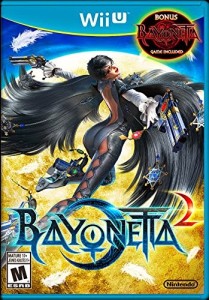
 After I featured it as my #1 game of 2014, you probably expected this. If you like action games and have a Wii U, you’re doing yourself a disservice by not looking into Bayonetta 2.
If you like action games and don’t have a Wii U, you might want to change that, especially with how great the Wii U’s lineup is looking.
But anyway, back to Bayonetta 2. I was already satisfied with my purchase, since I fell in love with the amazing original game, but I was a little nervous about starting Bayonetta 2 despite its great reviews. After all, sequels don’t always improve things. Sometimes they’re disastrous.
Other times, sequels are great, and I’m happy to say Bayonetta 2 is one of them.
If you have concerns about the game’s content, I direct you to my discussion of such controversial issues when I reviewed the first Bayonetta. In general, I’d say everything is less problematic in Bayonetta 2, although it is still far from a children’s game.
Now, onto the gameplay.
While awesome, a few things stand out as flaws in the original Bayonetta. For example, the QTE sequences that would lead to an instant game over if you missed them. No one likes those! (If you like instant-death quick-time events, I apologize… As someone who likes backtracking, turn-based combat, fixed save points, and other unpopular features, I know how you feel.) Bayonetta 2 cut those entirely.
Then there’s Bayonetta’s harsh ranking system. You know why you got Stone awards on almost every level your first time through? It wasn’t just because the game was challenging, but because the game did its best to trap you in lose-lose situations. Die? Penalty. Use an item to keep from dying? Penalty. Bayonetta 2 no longer punishes you for using items. Instead, getting through a chapter without using items awards you bonus halos.
Hidden verses and Muspelheim portals (the sequel’s version of Alfheim portals) are also easier to find, in part because the Muspelheim verse numbers for each chapter are right in your journal. The time span in which you can trigger Witch Time feels slightly longer, and Umbran Climax adds a great new mechanic for when Torture Attacks are unavailable or just not preferred.
Overall, the game is easier. I only died once or twice, in contrast to the million times I died in the original. Now, if that disappoints you, keep in mind that I played both Bayonetta and Bayonetta 2 on the normal difficulty level. Bayonetta 2 has a harder difficulty option available from the start, and people have compared it to the original’s normal difficulty. And it still presents a nice challenge–my willingness to use items was one of the greatest factors in my fewer deaths.
 The game features a variety of new enemies–including demonic enemies for the first time, which mixes things up nicely.
You see, in this game, Bayonetta isn’t just fighting angels. The forces of Inferno have also become her enemies, and she shows them no mercy on her quest to save her friend’s soul.
As you might expect, this personal quest eventually evolves into something larger, and the story is awesome.
Really! I know I’m in the minority when it comes to the first game’s story, since I found it intriguing while many people recommend ignoring it. Bayonetta 2’s story, however, is slightly more straightforward and very interesting–and the true beauty lies in how it works together with its predecessor.
That’s one of the mean reasons I recommend playing Bayonetta first. The sequel’s story will hit you so much harder, and change your perception of the original.
I only have two criticisms with Bayonetta 2’s story: first, I’d been looking forward to seeing how it would deal with the Umbra witches’ predicament of being doomed to Inferno because of their pacts with demons, but it didn’t get into those issues as much as I’d hoped. Second, new supporting character Loki was annoying…
But when those are my only disappointments, I can’t really complain.
Everything here is good. If you liked the original’s humor, it has a sense of humor. If you liked its story, this one makes the story even better. If you liked the combat, it’s here in all its glory, and if you liked its challenge, you’ve got multiple difficulty levels. Collectibles, costumes, transformations and powers, even a new multiplayer mode–it’s all here.
 |
| Also, Santa Rodin |
The only things missing are Angel Attack and the sense that the game wants to pummel you into oblivion, but if you really want those things, the original game is included.
So go now and buy Bayonetta 2, then join me in hoping for a Bayonetta 3! If you have any questions about this game, feel free to ask in the comments below, and I’ll help you as much as I can.
Buy Bayonetta 2 (with Bayonetta) from Amazon
Buy Bayonetta 2 (standalone) from Amazon
Buy Bayonetta 2 from Play-Asia

