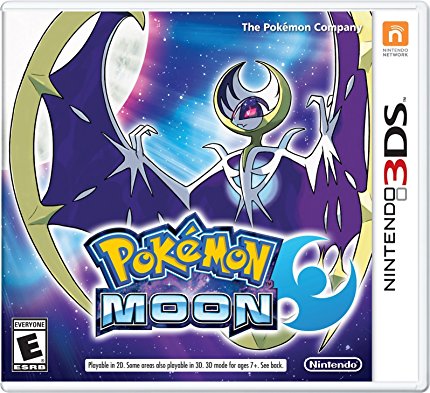
 After all this time, I’ve finally finished Pokémon Moon.
It took me well over a year to finish Pokémon Moon, despite being among the mainline Pokémon games I’ve put the least amount of time into. The way people raved about Sun and Moon, I couldn’t wait to play it, and yet I had trouble sticking with it.
Ever since Pokémon Black and White, I’ve been eager for more story-driven Pokémon games, but the numerous cutscenes and dialogue in Pokémon Moon drove me crazy. The problem here isn’t the story, though. It’s the pacing of these scenes and how they’re used.
Pokémon has traditionally had a “rival,” another character who becomes a Pokémon trainer around the same time as you and routinely shows up to challenge you. Later generations have leaned more toward a mix of rivals and friends. X and Y in particular had a whole group of friends, all of whom have their own goals.
Sun and Moon gave us Lillie and Hau.
Lillie isn’t a trainer. Having a friend who isn’t a trainer at all was an interesting choice, and she’s actually a central character to the story. In fact, I felt at times like Lillie was actually the story’s main character; I just happened to be a Pokémon trainer along for the ride.
Hau is a trainer, but not a particularly good one. I’ll admit, he really got on my nerves by the end. Before the games came out, I thought Hau seemed like a fun character. But he barely had a character arc (he went roughly from “I want to be stronger” to “I’m not strong enough” to “I’ll try to get stronger”), and his carefree, fun-loving attitude got really annoying when it was constantly interrupting my gameplay.
And that’s what I meant about a problem with the pacing. At some point, the writers must have realized that if a group of kids sets out on a journey from the same town to the same places, they should arrive more or less at the same time. The result? Nearly every single time you reach a new location, you’re interrupted by unskippable cutscenes involving Hau, Lillie, or both.
(Also, having a friend who isn’t a trainer and a friend who isn’t a good trainer are both interesting directions to take, but did we really need both in the same game?)
Now, I like having lots of story and dialogue. But most of the time, these scenes didn’t advance the story in any way! They’d just be Lillie being excited about a new town or Hau looking for a place to eat.
If they really want to go this direction with Pokémon, they need to find a better way to do it. Add an optional conversation feature, like Tales skits, when you reach a new town… or just have the friend characters waiting in-town or on the routes as NPCs that you can talk to if you want to.
But aside from the egregious pacing and pointless forced dialogue scenes, Sun and Moon’s story is actually pretty good.

I still think Black and White had the best story implementation of all the mainline games. That story used the Pokémon structure to its advantage, whereas Sun and Moon’s story felt like it was fighting the structure instead.
The pacing did drag it down, but the actual story moments and cutscenes were enjoyable. The villain was leagues above Lysandre (admittedly that’s not a high bar to pass) and arguably one of the most realistic antagonists we’ve had.
Click for Sun/Moon spoilers
While Lusamine came across as a bit over-the-top crazy in some ways, her relationship with Lillie (and to a lesser extent Gladion) felt realistic, particularly in how Lillie still loved her mother despite recognizing that she was abusive, and how she slowly learned to stand up for herself. They could have easily made Lusamine more of a Ghetsis-like character, but instead they let her character and her relationship with Lillie have shades of gray.
Speaking of which, if the Poké Pelago guy is Lillie and Gladion’s father, shouldn’t the player tell them?
On the other hand, it was disappointing that the world didn’t really show the consequences of the antagonist’s plan. Past Pokémon games typically have had a noticeable effect in the world when the villains act, with the most extreme probably being the Ruby/Sapphire/Emerald generation.
Here, it felt more like if I hadn’t been Lillie’s friend, I might have only had the vaguest idea that something happened. It’s fine to tell a more personal story, but we’re dealing with portals being opened to another dimension. They saved the visible consequences for the post-game, which we’ll get to later.
Sun and Moon’s story is one of the main reasons I’d recommend playing the game, but I wish it felt like more of a journey. It isn’t just the constant interruptions, but the way the world is structured. Pokémon games normally feel like a grand journey across the region, but since Alola is split across multiple islands – and you don’t travel between islands manually – it doesn’t have that same sense of freedom.
And everything seems so small. There are a handful of larger areas, but I often found myself asking, “Is that it?” after going through an area.
Click for Sun/Moon spoilers
Ultra Space was especially disappointing. When the portal opened up, I expected something like the Distortion World in Platinum, something that would be weird and surreal to explore and really emphasize that this is another dimension.
Instead it was basically just a pretty cave consisting of a hallway with Guzma and a room to fight Lusamine in. Really? That’s all we get for Ultra Space?
This also contributed to the weird pacing. After the painfully slow beginning, some of the parts later on feel rushed (such as a couple trials where you… don’t really do a trial…), and it just kind of throws you at the Pokémon League after the story’s climax.
The gameplay did some good things, too. Getting rid of HMs in favor of special Pokémon you can summon was a great decision, I found the Poké Pelago to be enjoyable, and I actually like Z-Move better than other additions they’ve tried. (On the other hand, the Festival Plaza is a major step down and the Rotom Pokédex is somewhere between annoying and pointless.)
Now, there are two main reasons I finished Moon instead of skipping to Ultra Sun/Moon. The first is that people say the story in Sun/Moon is stronger. The second is that Sun/Moon has a post-game story involving Looker.
In Pokémon X and Y, the post-game Looker quest managed to be more interesting than the entire main plot, so I was looking forward to this one a lot. Unfortunately, it was just okay.
Looker is still a fun character and the cutscenes were good, but the quest basically served no purpose except to show that yes, opening those wormholes really did have an effect on the world, and to increase the lore regarding wormholes, Ultra Space, and possibly the parallel universes. The story itself didn’t really do much, and gameplay-wise it just involved a lot of running back and forth between locations and trying to trigger battles with Ultra Beasts.
In the end, my feelings toward Pokémon Sun and Moon are pretty mixed. I tentatively recommend them for the sake of the main story… as long as you can endure the flaws along the way.

 I loved Amnesia: The Dark Descent.