
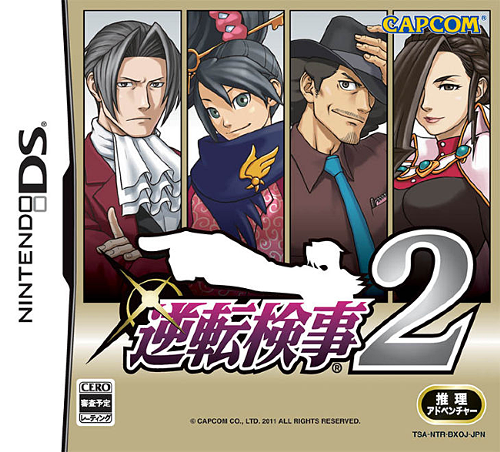
 Today is the final day of Celebrating All Things Mysterious 2023, and what better game to celebrate with than one we’ve been talking about since the earliest days of this blog?
Gyakuten Kenji 2, or Ace Attorney Investigations 2, came out in 2011. It is now the only game in the Ace Attorney series to not have an official release outside of Japan.
It did, however, receive a fan translation. I’ve spent over a decade now holding out hope for an official localization and have more hope for it in the aftermath of The Great Ace Attorney’s localization that I had in years, but last year I decided that if the year ended with no sign of further Ace Attorney ports, I would finally play the Ace Attorney Investigations 2 fan translation.
I wanted a copy anyway, just to have every Ace Attorney game, so I imported a Japanese copy of Gyakuten Kenji 2 from Play-Asia.
And when May came, I began the process of learning how one actually plays a DS game fan translation, which was a bit like jumping into the deep end since the closest I’ve come to anything of the kind was playing the fan translation of Chaos;Head, a PC game I could simply buy, download, and apply the patch to. So actually figuring out how to play Investigations 2 (particularly since I wanted it on a flash cart so I could play it on my 3DS without hacking it) took much longer than I expected.
But at last, I was able to play Investigations 2 with its fan translation.
Picking up after the events of the first Investigations, Investigations 2 once again puts you in the shoes of Miles Edgeworth as he investigates a new series of cases. If you’ve never played Investigations, it plays a bit differently than the main Ace Attorney series. For investigations, you actually walk around as an Edgeworth sprite to inspect areas in the environment. You also confront people directly, hearing their testimonies and presenting evidence against them, instead of having that occur in a trial. They are essentially investigation-only cases, but with mechanics made to adapt Ace Attorney’s regular style to that format.
Investigations 2 also adds two new gameplay features, Logic and Logic Chess. In addition to evidence, you’ll also receive clues that you can then connect to one another through the “Logic” mechanic. This is usually fairly simple, but it was fine.
Logic Chess, meanwhile, puts you in a confrontation with a character who won’t reveal their secrets. It has little to do with actual chess and is essentially a timed series of dialogue choices to break through a character’s resistance, while chess pieces float on the screen to represent the character’s defenses. There are times when you need to pick the option to wait without saying anything, so it becomes a game of judging from the character’s responses whether you should speak or not. Sometimes it felt a bit too arbitrary, but overall I found Logic Chess to be a fun mechanic.
Moving on to the story, it was easy to forget I was playing a fan translation. It feels like Ace Attorney writing. Occasionally I found the game’s questions to be worded in a confusing way so that I wasn’t quite sure what it was asking me for, but I’m not sure if that’s because of the translation or the original writing.
Anyway, it brings back returning characters while also introducing several new ones. Most of the new characters were fairly likeable, with one in particular getting such a character arc that I have to admire the writers for making my opinion of a character change so dramatically over the course of the game. And while I unfortunately got spoiled on the main antagonist’s identity ahead of time, the reveal still gave me chills.
There’s plenty of Ace Attorney humor, as well, although I didn’t find it to be as funny as some of them are. It also has a lot of callbacks to the previous Ace Attorney games, much more than I expected. That was a fun surprise.
As for the story itself, I’m going to need some time to think everything over. You see, Investigations 2 has an overarching story, but the way things come together don’t become apparent until near the end. Each individual case has its highs and lows, but once I started to see how events were connected, I found myself wanting to go back and see them again with new context. And the character writing was so good that a few key moments alone made me love the game so much more.
I only have three real criticisms of the story. First, I felt the pacing dragged on a bit. Most cases felt a little longer than they had to be. My other two criticisms are spoilers, so I’ll explain them behind spoiler tags.
Overall, I greatly enjoyed my time with Ace Attorney Investigations 2. While I need some time to let the story think in to determine where it sits in my Ace Attorney rankings, I definitely had a good time with it.
You might think that this lessens my desire for an official translation… but you’d be wrong! No, I want Investigations 2 to get a port and localization more than ever now! I want more people to play it. I want to be able to recommend it to friends without a list of instructions on how to play it! The fan translation is great, so maybe Capcom could work out a deal to use it as a base for an official release, like what happened with the Crossbell games. Playing it just cemented how much I not only want the remaining mainline games to be ported to modern platforms, but the Investigations duology as well.
So I’m still hoping for an Ace Attorney Investigations 2 localization after all this time. The sole other time I’ve played a game’s fan translation, localization was announced five months later, so maybe that same magic will occur again!
Gyakuten Kenji 2 can still be found out there, but being a Japan-exclusive DS game makes it among the most difficult Ace Attorney games to play. Here’s hoping Capcom remembers it and gives Investigations another chance.
And that brings this year’s mystery game celebration to a close! You have until the end of tonight to leave comments for the contest, so join in the conversation with your thoughts on Ace Attorney Investigations 2 and all the other games we’ve discussed this month!

