
Resident Evil: Revelations.

It can’t catch a break.
I’ve mentioned this game a few times, and not positively. In my first-ever blog post, I described it as a “step in the right direction,” but decried it and games like it as “half-hearted, watered down compromises.” Last month, I referred to Revelations as “a half-way attempt” when considering the future of the Resident Evil series.
Now that a sequel has been announced, it’s time I take a look at this game once again.
“Revelations is not survival horror.” A lot of people consider those of us who make such a claim to be nostalgic whiners who will never be pleased with anything. Is that true? Let’s break it down.
Back in that first blog post of mine, I said a survival horror game must have:
“a disturbing or frightening atmosphere, de-emphasized combat, a maze-like environment that encourages exploration, and puzzles”
I’ve since refined my description. The essential elements for a survival horror game are:
- Horror elements (“a disturbing or frightening atmosphere”
- De-emphasized combat
- Recursive unlocking (“a maze-like environment that encourages exploration”
Puzzles are a tricky issue. Some are clearly puzzles, like the riddles in Silent Hill or the water puzzle in Resident Evil 3. Others are more ambiguous. If you need to put a gem in a statue to get a key, is that a puzzle? If it is, is using a medallion to open a door also a puzzle, or is that just a part of the recursive unlocking? And if that’s a puzzle, doesn’t that mean it’s a puzzle whenever you use a key, or if you unlock doors with a key card you found?
Due to the ambiguity of puzzles, I now consider them a secondary element. Two elements that help survival horror, but are not necessarily required are:
- Puzzles
- Apocalyptic logs
Of course, there are many optional elements often mistaken for what survival horror fans want, such as fixed camera angles, save points, and inventory management. These things help, but they aren’t vital, and they can’t carry the game on their own.
So, how did Resident Evil: Revelations do?

One out of 5 isn’t bad… but it isn’t good, and it doesn’t make it survival horror.
Revelations is horror. I’ll give it that much credit. It even had a creepy atmosphere on the ship, and some moments were tense. There were some monsters I was terrible against, and I became nervous whenever I heard their signature sound–a definite trait of survival horror games. Attempting to use the Genesis Scanner to earn more herbs and unlock bonuses was also a nice, atmosphere touch.
The checkpoint system took away from the gameplay’s suspense, though, because you almost never lost significant progress.
I take that back. I managed to lose a chunk of progress when I got a checkpoint, then wandered in the opposite direction of the objective to explore as much as I could. Since there were no checkpoints along the non-plot path, I lost my exploration progress when I died.
On one hand, I want to say this is a good thing–exploration is a part of survival horror, so if you play it more like a survival horror game, you’ll have to fear lost progress.
On the other hand, the game punished me for exploration.
I wish I could say Revelations had de-emphasized combat. Two years ago, I said:
“There was no reward for fighting enemies, and many could be avoided. While there were more sections that forced you to battle than the original games had, this is probably the point where Revelations came closest to truly ‘returning to series roots.'”
However, at the time, I was discussing only the parts of the game set on the ship. While most of Resident Evil: Revelations was set on the Queen Zenobia, other chapters switched to different characters or to flashbacks, usually with a hefty dose of action. The developers hyped this as a feature, because apparently players would get too bored if they didn’t get a break from the survival horror gameplay.
For every area where you could avoid combat, there was an action-fest waiting elsewhere. Half credit for de-emphasized combat, I suppose.
Recursive unlocking is where I felt not disappointed, but betrayed by Revelations. When I revisited the demo to see where it led me astray, I described it as “window-dressing . . . superficial shout-outs to the classic games to pretend that’s what it was.” Unless you’ve played it or something similar, you can’t imagine how excited I was when I saw a door that needed a Helm Key. It felt just like the system of locked doors and keys in the early games.
It wasn’t. Sure, you might find a key that unlocked three doors, but would those three unlocked areas give you more pieces to gradually progress forward? No, one would lead to the next plot point and the other two would contain some herbs or ammo.
And that leads us to the problem of puzzles.
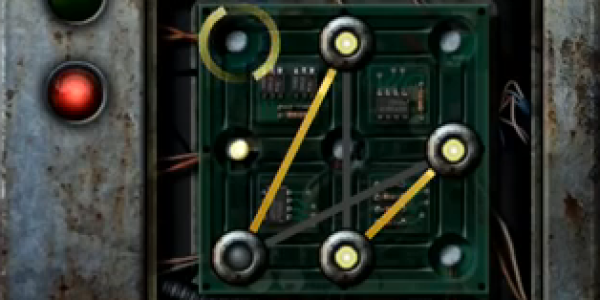

What do you think? Fun puzzle, moving the wires around so that they form a shape and all light up, which unlocks the door for you? I hope you said yes, because this is Revelations’ puzzle.
I don’t mean it only had one puzzle. I mean the majority of them were this exact type. If you encountered a puzzle, chances were pretty good you needed to use you screwdriver to open the panel and solve one of these.
Other “puzzles” fall back into the category of superficial shout-outs. There were a handful of item puzzles (such as a slot for a medallion) that, when I saw them early in the game, convinced me classic RE-style puzzles would fill the game. They didn’t. A few existed just to call back to the originals (or to trick people into thinking there would be puzzles).
There were a couple of notes that also served as series fanservice, but not enough to be considered Apocalyptic Logs. After the demo, we had all kinds of story theories based on the “hints” we thought we saw… nope. Not that sort of game, not that sort of storytelling.
Before I played Revelations, I saw people describe its story as weird and convoluted. I was okay with that, because I have nothing against games with weird, convoluted stories.
But it isn’t weird and convoluted in the same way as Professor Layton games, where you just have to roll with the insanity. Revelations’ story is weird and convoluted in the way where you don’t really know what’s going on, and when it’s all over, you don’t really care. (Apologies to anyone who enjoyed the story, but I found it particularly unmemorable.) And instead of giving you a single story through the eyes of one or two protagonists…
You play as Jill for the majority of the story, often accompanied by an AI partner named Parker. Some chapters switch to Chris, accompanied by AI partner Jessica. Then there are flashbacks where you play as Jill and Chris. Flashbacks where you play as Parker and Jessica. Concurrent missions where you play as Quint and Keith, two side characters so annoying that some reviews docked points just for them.
I enjoyed parts of Resident Evil: Revelations. I might go so far as to call it a decent game. However, you’ll notice the lack of affiliate links in this post. It doesn’t deserve that much credit from me.
It was unfocused, unmemorable, and definitely not survival horror. Yet it took a step toward survival horror. Overall, it gives the impression that its creators were afraid to make the survival horror game they wanted to.
Revelations tried and tried to return to series roots, but in the end, it couldn’t.


