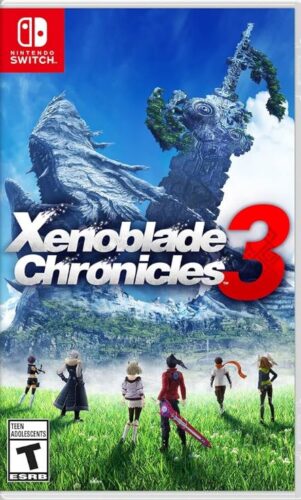
 After all this time, I finally finished Xenoblade Chronicles 3.
Not under my own initiative, mind you – the contest winner from this year’s Celebrating All Things Spooky picked the review prize and chose Xenoblade Chronicles 3: Future Redeemed, so I sat down to finish the main game first.
So how did we reach a situation where a game I was extremely excited for all the way up to its release is one I had to be pushed into finishing over two years later?
It’s not nearly as straightforward as with Lost Judgment, where I had to catch up on the main Yakuza series first. No, with Xenoblade Chronicles 3 it’s harder to define.
Xenoblade Chronicles 3 is a great game. I’ll say that right now. It’s a great game, and it has a lot of stuff in it that I enjoyed. I poured nearly 150 hours into it. But it’s probably my least favorite Xenoblade game.
I have been in love with the Xenoblade series from the start. I’ve been obsessed with every single one before now, to the point of playing the first game’s definitive edition and planning to do the same with X’s even though I almost never replay games, especially such long ones. But that didn’t happen this time. Last year, I even expressed my surprise that I kept putting 3 aside for other games instead of being addicted to it.
For a long time, I couldn’t figure out why, but now that I finally sat back down with it to play it to completion, I think I understand.
Xenoblade Chronicles 3 is set in a world fueled by constant war between two nations, whose people continually war with one another while being limited by 10-year lifespans. There are six main characters, three from each nation, who end up breaking free of this cycle and teaming up to learn the truth about their world. This means you have your full party of six very early in the game, and I think that took something away from it for me. Gradually meeting new party members is one of the things I love in JRPGs. It made it harder for me to grow attached to them when all six were already together so soon.
Now, you actually fight with an active battle party of seven, with the seventh being a Hero. Heroes are special characters you recruit, usually through side quests. This does add an element similar to building a party, since each Hero has their own quests, but it’s not quite the same since only a specific few play a role in the main plot.
Heroes also play into the class system used in combat. Instead of each character having a set role, every Hero you recruit unlocks a new class you can play as. Trying different classes is a lot of fun and one of the things I enjoyed.
Combat in general is great, too. There are some nice new features, like finally the ability to fight in water and indicators that show if you’re in front of, behind, or flanking an enemy. Chain attacks here are my favorite in the series, with different ways to connect characters’ attacks to try to do the most damage possible. I ended up pretty over-leveled due to side content, but in general I found combat fun.
Moving on to another part that made this game click less for me, however, I found the world less interesting to explore than in past Xenoblade games. The exploration gameplay itself is fantastic – lots of secret areas to discover, tons of side quests and new Heroes, and zones that just keep opening up more and more – and it reintroduced the concept of field skills without the tedious aspect from 2; here they’re just passive abilities you learn and then have forever. But exploration in every other game gave me a sense of wonder, excitement that came just from wanting to see what was around the next corner, that I didn’t feel here.
Part of that just comes from the nature of the world. A world trapped in constant war is bleak, and instead of regular towns and cities you have Colonies that aren’t as clearly distinct from one another. So they fit with the story, but that cut into my excitement despite having so much to explore.
And now let’s talk about the story. For the first few chapters, I was hooked. Everything seemed so mysterious and intriguing. I couldn’t wait to learn more. But… the longer it went on, the more my interest in the story started to fall apart. This is partly due to the villains, of whom there are a handful of interesting ones alongside an unfortunately large number of blander, almost cartoonishly evil villains who sucked away their sense of intimidation and mystery by just being annoying.
Click for Xenoblade Chronicles 3 spoilers
I really, really could have done with a lot fewer Moebius. Beating a Consul almost every time I freed a colony made them stop feeling intimidating outside of maybe N. The regular ones just started feeling like they could be any generic bosses.
If it was just D, N, M, J, S, and maybe a couple others (and of course Z) instead of feeling like they were trying to fill out the whole alphabet, I think they would have felt more unique and dangerous.
The letters for names also made it hard for me to remember who was who, causing them to feel even more interchangeable for me.
(Speaking of which, the party members also tended to have backstories that all followed similar beats, which contributed to things feeling same-y, too.)
Note: none of my Moebius complaints apply to Triton, who is one of the best Heroes in the game and one of the parts in the second half of my gameplay that really delighted me. All these other Consuls are running around killing people for fun and twirling their metaphorical moustaches, and here’s Triton just having a grand old time as a pirate and fondly remembering his old mortal friends. He’s great.
It also felt like it didn’t capitalize on those early mysteries as much as I expected it to, and it was missing the sort of huge revelation past games had that turned everything on its head.
Some parts of the story were great, don’t get me wrong. It has one especially emotional moment that I just wish could have held its impact longer. But between feeling less attached to the main characters, not appreciating most of the villains, and not feeling the payoff of the early chapters as much as I expected, I had trouble staying invested in the plot.
All in all, what it comes down to is this: the other Xenoblade games are ones I’ll gush about as being exceptional JRPGs that blew me away. 1 and 2 each knocked it out of the park with their stories, and while X faltered there, it made up for it with incredible worldbuilding. In contrast, Xenoblade Chronicles 3 was fun, but not one I put on that same level.
But I have yet to play Future Redeemed, so we’ll see how I feel about that! In the meantime, what did you think of Xenoblade Chronicles 3?

 During the incredible Nintendo Direct back in August, we got the surprise reveal of Trails in the Sky the First, a full remake of the first game in the Trails series.
